
As promised in Part 1, here’s a post on polyforms made from half-weight tans on the tetrakis square grid. The pieces with three and four of these collectively have weight·area 16, so we get to continue our run of square tilings. We can notate this set as {3, 4}·½ ◢. (This use of braces is a new addition to my notation, but is intuitive enough, I think.) Here are the pieces:

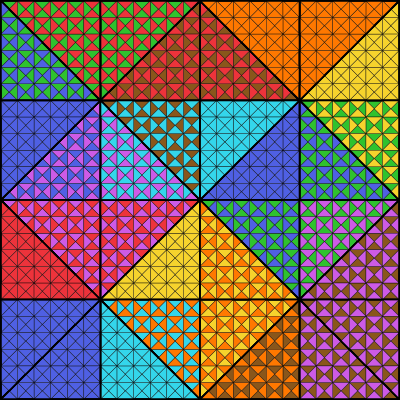
It can be challenging to pick the pieces out from this image of the 4×4 tiling, but they are all in here, I promise:
There are, in fact, two different n×n subgrids of the tetrakis square grid for even n. If we overlay the two subgrids as shown, we get a grid where all four orientations of a tan within a square cell are present:
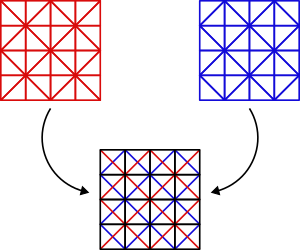
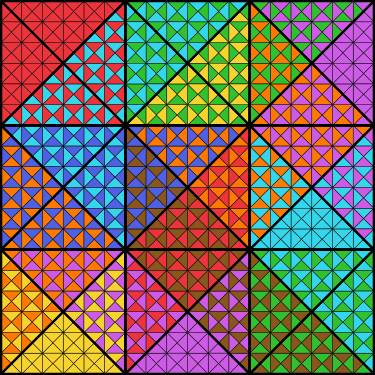
This grid (as extended to the plane) has the property of being “noble”, that is, all vertices and all tiles are equivalent. The tetrakis square grid itself is not noble, as there are two different kinds of vertices. (Even though this grid looks like a tetrakis grid, the points where diagonals intersect are not vertices.) The subset of the n·½ ◣ without any half-tans in coinciding positions will fit on the melded grid. The {1, 2, 3}·½ ◣ with this property can tile a 3×3 square:
There is a (perhaps surprising) link between polytans in this grid and polykings. Consider the graph made by joining connected tiles in the melded tetrakis square grid:
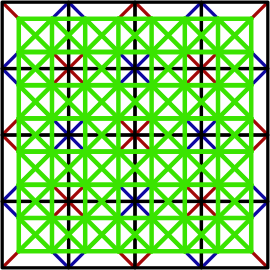
These connections are a subset of the ones possessed by the graph moves a king can make on the regular square grid.. We can represent the missing connections by adding voids at certain corners. Then we can tile the “{1, 2, 3}-kings” on this grid:
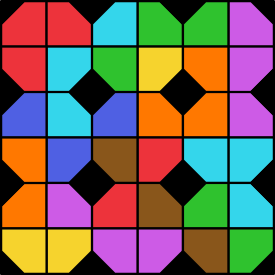
This tiling is equivalent to the previous one. It loses some elegance by not using a noble tiling, but it certainly gains legibility! One advantage to this format is that I could use it directly in Polysolver. The other tilings in this half-tan miniseries, (excepting the one Bryce Herdt found in the previous post) I found manually, with some tedium.
And that’s all I’ve got on poly-half-tans! As an aside, nobility has been in the news recently. Connor Hill recently proved that there are exactly 146 noble polyhedra, plus a few infinite families. His paper is here, and there was also a good Numberphile video on the topic. I don’t know if the noble multiple euclidean planar tilings have been similarly characterized, but they would make an exciting vein for polyform exploration.
