
I left polytans out of my post about polyforms with fractional weight cells. They behave a little weirdly, and deserved their own post. Which is this one! But first, a notation consideration. Previously, I made the distinction between glom polytans, where tans can be placed in arbitrary orientation as they are glommed onto another tan, and grid polytans, where tans are constrained to the tetrakis square grid. Both of these polytan types seem important enough for my notation system to capture. Luckily, Unicode provides us with more than one right triangle. So, we’ll give the glom polytans “◣”, because that triangle stands to the left, and let the grid polytans have “◢”, which stands to the right.
That out of the way, we’ll focus on glom polytans in the current post. When I described how to make polyforms from fractional weight cells, I allowed the cells to stack entirely on top of other cells as well as to be placed adjacent to other cells. With polytans, there is another possibility. Here are the pieces that I consider to properly constitute 3·½◣:

Above, areas where two half-tans overlap are shown in a darker shade. The first two rows contain well behaved pieces, but in the third row, there are half-tans with partial overlap. We can make these by loosening our rule of how glomming works. It becomes:
- Select an edge of a cell.
- Place another cell on either side of that edge such that an edge of the new cell entirely coincides with the selected edge, and at no point does the entire weight of cells present exceed 1.
I’ll grant that n·½◣ tans containing partial overlaps look a little weird, and one could reasonably choose to exclude them. I have chosen not to do so in part because if you start with a larger set you can make a subset with desired properties by filtering out undesirables, but if you start with the smaller one, you can’t recover the larger. Anyway, 12 3·½◣ have enough area·weight to fill a 3×3 square. Bryce Herdt found this piling:

If the pieces with partially overlapping tans are removed, the remaining 3·½◣ have area·weight 6, but throwing in the three 2·½◣ restores our ability to fill a square. Here’s a {2,3}·½◣ piling of a 2√2×2√2 square:
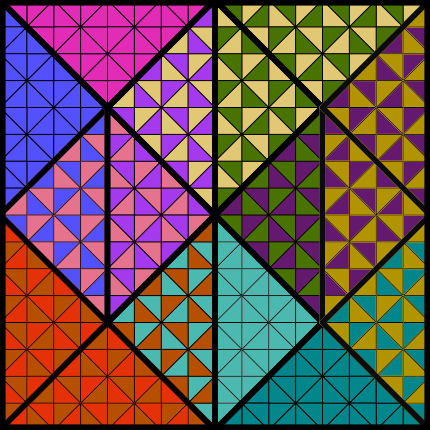
A non-trivial tiling problem in a 3×3 square may have seemed unlikely enough, but leave it to the fractional tans to inhabit one in an even smaller square! As the title of this post suggests, I intend to write another post about fractional grid polytans sometime soon. I also have a bunch more to write about my notation scheme. Hopefully I can finish that off before the decade is out, but I might have to work on blogging more prolifically for that to happen.
