Notation Notions: Addition Addendum

1.

Previously, we looked at what we might mean by such things as “The 3+2-ominoes”, and distilled the beginning of a notation system from that. But before we get very far, we might find some instances where our polyform set addition notation is unsatisfactory. Here are the 2+1+1-ominoes, or 2+1+1■ for short:

It strikes me as I look at these that sometimes I might want to be able to refer to a set that works like just the top row of these. “I want a domino, with a couple of monominoes attached directly to it. Show me all of the ways to do that!” For this, we’ll need a new operator, which I’ll write with a colon and call the with operator. We can now call the top row set 2:(2⊙1)■, or “domino with two monominoes” spoken informallly.

2.

A variation we might want for n+n-forms is to exclude compound forms containing repeats of the same part. For example, in Problem #59, we looked at a component coloring problem involving heterogeneous ditrominoes. We can coöpt “choose” notation, \({S \choose k}\) to give us all of the ways to attach k forms from the polyform set S. Thus we could write the heterogenous ditrominoes as \({3■ \choose 2}\).

As it happens, Bryce Herdt recently solved problem #59. I had shown a component 4-coloring where the L3’s could take two different colors and the I3’s could take the other two colors. (L3 and I3 are the standard abbreviations for the L tromino and the straight tromino.) The problem was to make the 4-coloring strict. Herdt not only succeeded in this, but the 4 possible combinations of colors in a ditromino also make a strict 4-coloring. I have identified each of these color combinations with an outer border color in the diagram below in order to highlight this second 4-coloring.
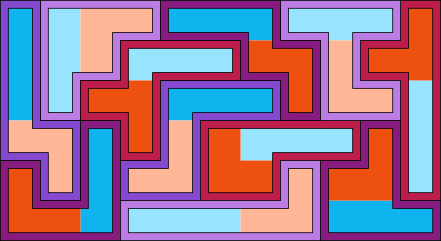
In this case, another way to notate the same set would be L3+I3. Of course, we aren’t defining addition on polyforms themselves, but rather polyform (multi)sets. So let us use the notational convention that italicizing a polyomino abbreviation gives us the set with just that polyomino as a member. (As only polyominoes have standard single letter names, the “■” can be omitted.)

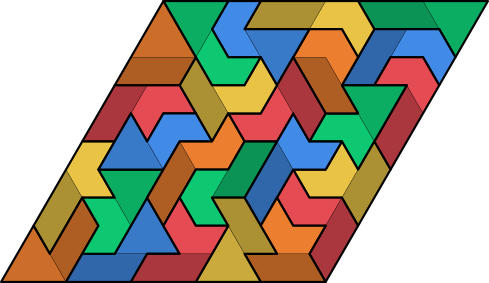
For another example, here are the 25 heterogeneous di-tetriamonds, or \({4▲ \choose 2}\). Since the number of cells is twice a square, they can tile a rhombus of edge length 10.
I still have more entries in this series planned. A comprehensive system of polyform set notation may never be able to describe every set of polyforms we might encounter, but to the extent that it can make exploring and keeping track of polyform sets easier, it does seem like a worthy goal.

Border Marking

This might, at first glance, appear to just be a random tiling of a bunch of dominoes and trominoes.

But what would be the point of such a thing? In fact, it’s a complete* set of dominoes and trominoes where edges may be marked, and the marked edges are exactly the ones that can occur on the border of this tiling. That thick rectangle around the tiling is part of the pieces!

*There is, in fact, one more tromino with markings that could fit in that rectangle. But if we included it, there would be a single cell in a corner that would be unfillable, since we’ve specified that the tiling has only dominoes and trominoes. Therefore, by the rule of exclusion of things that would be awkward to keep around, it has to go.

That this works at all, even with this minor fudge, feels like a pretty bit of luck. Not only do we have a perimeter and area that are compatible, we have exactly the usual number of corners for a rectangle.

With polyiamonds, I thought my luck ran out. No combination of sizes gave me compatible perimeter, area, and corners. But when I abandoned corners entirely, and focused on pieces with only one marked side, I found that a parallelogram with opposite sides marked could be made using the 2-, 3-, and 4-iamonds. Since it wouldn’t do to have any unmarked edges lying bare to the outside world, I wrapped that parallelogram into a cylinder:

And here are the pieces individually:

Sometimes when I have a novel polyform puzzle idea, I feel like I’m tapping into a rich vein of possibilities. Here, I’m not so sure. The problem is that when you move up to sets with larger sizes of polyforms, the area and border segment length are unlikely to scale in a way that gives you tilings with completely marked borders. But I would love to be surprised!

Cell Numbering Sums

Before I started this blog, I explored polyominoes with cells individually labeled with numbers. I called these sumominoes, as I was looking at sets of all polyominoes with a given sum. Erich Friedman discovered them independently, and called them weightominoes in his July 2009 Math Magic Problem of the Month. I prefer his term for the general concept, as there is no reason they need to be grouped by sum. Both Friedman and I looked at problems where the goal was to overlap these polyominoes in a rectangle so that every cell had the same sum of labels. While I looked at a particular complete set, Friedman looked at pilings of multiple copies of the same cell numbered polyomino. (Aside: “pilings” isn’t a standard term, but it’s a concept we need a term for. We have “packings” for deficient tilings that don’t fill a space, so “pilings” for abundant tilings that fill it with overlap. Then a “tacking” is when there is both empty space and overlap, of course.)

All polyominoes with positive integer labels that sum to 4.

In this kind of problem we looked at sums of cells in the “z” direction. But we could instead look in the x and y directions. There is a common type of figure where we do this already: magic squares!

For this type of problem, excluding 0 as a potential cell label isn’t necessary. Standard numbered dominoes include 0 (blank) as a label, so we might want to do the same for physical puzzles using pips. (Pip patterns are preferable to numerals for physical puzzle pieces since they don’t have a preferred orientation.)

In fact, in the context of standard dominoes, examples have existed for some time. Here is a domino magic rectangle using a full set of double-six dominoes. The row sums are all 24, and the column sums are 21.

Solution from “The Existence of Domino Magic Squares and Rectangles”, by Michael Springfield and Wayne Goddard, graphic mine.

Of course, the fact that it can be done doesn’t make it a good puzzle, and working with a full set of dominoes might get tedious. Since I’ve been looking for simple puzzles with small piece sets, I tried to find one in this format. There are two cell numbered dominoes and four L-trominoes with a cell sum of 2. Their total area is 16, good for a 4×4 square,. and their total label sum is 12, giving a row and column sum of 3. One nice thing about a magic square type puzzle is you get an extra challenge for free. Finding a configuration with just row and column magic sums is a fairly light challenge, but getting the main diagonals to also match the magic sum is much harder. I had a small number of these made to give away at the 2022 MOVES conference:

Show Solution

Looking upward in size, there are 12 trominoes with a cell sum of 3, good for a 6×6 square with line sums of 6. I made a prototype:

But this isn’t quite as great as a puzzle, which is why I didn’t bother to conceal the solution as a spoiler. The reason is that it’s easy to make subunits where pip sums are preserved on applying a symmetry action. For example, in the solution above the three I trominoes in the upper left can be permuted in any order without changing row or column sums. Likewise, the two 2×3 rectangles formed from two L trominoes on the bottom can be flipped over one axis. This makes it much easier to turn a semimagic (row and column only) solution into one where the diagonals also work. (Subunits like these can appear in the smaller puzzles here, but there isn’t really enough room for them to dominate a solution.)

What I really want from going one step up from a 4×4 puzzle is a 5×5 one. Well, if we exclude the pieces with 3’s, we have an area of 24, which is almost right. We can make a 5×5, but it would have an unfortunate hole:

Or a fortunate one! Since my pips were lasered out holes to begin with, the big hole should clearly just count as one hole for the purpose of line sums. Now we have 25 holes, and 5 will work as the line sum. (While I normally like rounded corners for pieces since they have a softer tactile feel, if I made more of these, I’d use sharp corners and square pip holes, to visually unify the two different hole sizes.)

Show Solution

Is there anything else we can do with cell numbering? Polyhexes seem promising since there is an extra direction for sums to happen on. And perhaps we can use the numbers for something other than sums. I’m sure there are more creative discoveries waiting to be made!