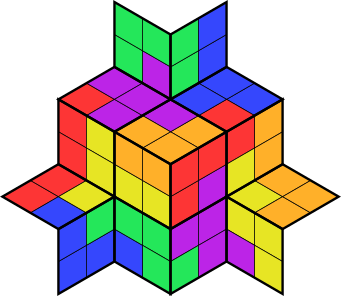
Rescued by Flexible Polyominoes

See the previous Flexible Polyomino post here.

One unfortunate lesson that you quickly learn about tiling problems involving a full set of (free) n-ominoes is that the pentominoes are the only really nice set. Monominoes through trominoes are trivial. And tetrominoes and hexominoes have checkerboard parity problems. Here’s an example. Suppose we wanted to tile a figure containing five copies of a 6×7 rectangle with the hexominoes. (It might be a 30×7 rectangle, or a 35×6 rectangle, or something more fanciful.)

These rectangles (suitably checkered) have an odd number of both black and white squares, and since an odd times an odd is odd, so do five of them. But 11 hexominoes are “even” (they will always cover an even number of both black and white squares) while 24 are odd (they cover an odd number of squares of each color.) Since an even number times an odd number must be even, there must be an even number of squares of both colors in both the even and odd hexomino subsets, and thus also in the full set. So our figure is impossible to tile.

But flexible polyominoes come to our rescue. This figure, formed from five of the above rectangles with a little distortion, can be tiled with hexominoes!
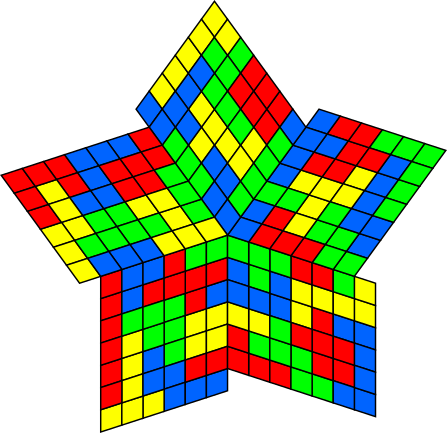
Why does it work? Well, consider what it would mean to checker the underlying cells. There is a cycle of five cells around the center. If you color one of the cells white, then as you go around the center, the next cells would be black, then white, then black, then white again. But the following cell would be the one where we started, and it would have to be black! So you can see that whenever we have an odd cycle of cells, we can’t have a consistent 2-coloring, and the checkerboard parity argument above no longer applies.

Note that there’s no magical property of flexible polyominoes involved here, just the presence of an odd cycle. The following figure has no odd cycle, so checkerboard parity applies, and it turns out to be untileable with the hexominoes.

Checkerboard parity problems can only occur with sets of even-sized polyforms. Our next odd size is the heptominoes, but here a new problem emerges. One of the heptominoes has a hole:
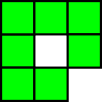
Thus every heptomino tiling must either incorporate a hole or omit the holey heptomino. Either solution is inelegant. Flexible polyominoes rescue us once again!

Solution by Edo Timmermans

The holey heptomino is there, but the hole is not. Can you find it?

Once you move to the octominoes and beyond, “opening” a holey polyomino can require breaking a connection between cells, so we’ll stop here. But the 9-iamonds, like the heptominoes, have a single holey piece where the hole is pinched together with disconnected “fingers”.

Problem 54: Tile this figure with the flexible 9-iamonds. There are 160 9-iamonds, which brings us into the zone where we’d want a pretty efficient solver in order to make headway.

This gets us through most of the 2022 Flexible Polyform Renaissance material that I wanted to post, but there is still enough for a brief coda, which I hope to complete soon.

Revenge of Flexible Polyominoes

Several months ago, I felt myself at a bit of a creative ebb. I wasn’t coming up with any bold new polyform ideas, so the best I could do would be to tinker around in a space that was already well-trodden. In this state of mind, I asked myself: did Abaroth miss anything good?

When I came up with the idea of letting the cells in polyominoes be flexible rhombi, Abaroth ran with it, and made an entire gallery of tilable shapes with solutions. Some of Abaroth’s discoveries used rows of squares as seams between the “leaves” of a target shape, but he missed this nice pentomino star:

An obvious thing to want after seeing a tiling like this with five-fold dihedral symmetry is one with sixfold dihedral symmetry. So far, the attempts have run into some problems.

The tiling on the left is Abaroth’s. It contains a couple of ambiguous pentominoes in the upper right. Where the green one wraps around a degree-3 vertex, it could be “unglued” to form either an X or an F pentomino. The red one could be an L, an N, or a Y.

The tiling on the right is mine, and has a different problem. The P pentomino in the upper left is not ambiguous, but it is split. This type of flaw can only occur in a polyomino that contains a square tetromino; P is the only pentomino that does.

Problem #53: Find a flexible pentomino tiling with sixfold dihedral symmetry without ambiguous or split pentominoes.

One-sided flexible polyominoes were another area that had been missed. It turns out that there are some nice tilings here:

George Sicherman, Abaroth, and Edo Timmermans all found one-sided pentomino tilings for the above double star. This double balanced three-coloring found by Edo Timmermans is particularly nice. Remarkably, the one-sided hexominoes also admit a double star:

(Solution again by Edo Timmermans.)

It might not be clear at first that other symmetry variations on polyominoes will survive in this weird flexible world, but in fact some can. If squares can flex into rhombi, then rectangles can flex into parallelograms, and we can get tilings like the following, using the 3-, 4-, and 5-rects:

For the second post in a row, I’m going to stop with at least another post’s worth of material left to share. If I leave you in suspense, you’ll have to keep coming back, right?

A Polyformist’s Toolkit: Connections

We may say that a polyomino is a connected set of squares in a grid; now I want to examine what we mean by “connected,” and what we can mean.

The usual definition requires cells to be connected along their edges. A common variation allows cells to connect either with neighbors either by edges or by corners. These have been variously called polykings, polyplets, and pseudo-polyominoes. My personal preference is polykings: I know what a chess king does, and it immediately suggests how a polyomino variation based on the concept would work. I don’t know what a plet is, and pseudo is both wrong, (there’s nothing fake or false about them) and unspecific, (if we are going to go around calling things false polyominoes, we have plenty of options.)

The 22 tetrakings.

Wikipedia titles its page on them Pseudo-polyominoes, because Golomb called them that in his book, and printed books override all other forms of knowledge. Except, at the time I am writing this, everywhere on that page except for the title, where Wikipedia continues to calls them polykings.

Unfortunately, rather than leave well enough alone and stick with just “polykings”, I’m going to introduce my own confusing and awkward terminology. Because there are actually many more choices for ways to associate pairs of connected cells on a square grid, and we’re going to need a systematic method to keep track of them. As with “polykings”, chess piece moves more generally can correspond to allowed connections between cells in a type of polyomino. And we may turn to a standard notation for chess piece moves, which was developed by Ralph Betza and adopted more widely by chess variant designers.

The initials used to designate short piece moves mainly come from pieces in historical versions of chess. W, for Wazir, (Persian, minister or vizier) is the one orthogonal space move,. F, for Ferz, (Persian, counselor) is the one diagonal space move. D and A are for Dabbaba (Arabic, siege engine) and Alfil (Arabic, elephant) respectively. N is the standard initial for a chess knight, since the king takes the K. Instead of polykings, now we may speak of poly-WF-ominoes. Likewise, we can construct poly-WD-ominoes, and poly-WFD-ominoes, etc. Peter Esser has looked at the poly-WFD-ominoes, which he calls “Far-Bridged Polyominoes”, and also some symmetry variants based on them.

Not every possibility is equally interesting. For example, the poly-F-ominoes are equivalent in a way to the poly-W-ominoes: by rotating and dilating the positions of the cells, you can uniquely transform any of the former to one of the latter.

There is a practical problem with the poly-WF-ominoes and some of the other connection based variants we can come up with. The sets generally grow so fast with the size of polyomino that they skip right past the domain of practical manual solvability. Twenty-two 4-WF-ominoes is just too many, but five 3-WF-ominoes is trivial. But if we observe that just 12 of the 4-WF-ominoes aren’t W-ominoes or F-ominoes, we get a set that is manageable. We can call these the proper 4-WF-ominoes, and define them more formally as all of the 4-WF-ominoes for which every spanning tree of connections contains at least one W-connection and one one F-connection.

Unfortunately, the proper 4-WF-ominoes have odd checkerboard parity, so we can’t use them to tile a rectangle. I did however manually find a tiling of a 7×7 square torus with the proper 4-WF-ominoes plus a monomino.

Problem #51: There are some improvements upon that solution I’d like to see. How many of the following can be achieved, either individually or together?

  1. Avoid any “Fault lines”, or runs of border segments that pass all the way through a tiling. With standard polyominoes, this is rarely difficult. These pieces have fewer orthogonal connections that can block a fault line. There are 14 rows and columns, and only 18 orthogonal connections, so they must be spent somewhat carefully.
  2. “Crossroads”, or vertices that join four border segments are unavoidable due to the diagonal connections. A constraint that would be equivalent to “No crossroads” for standard polyominoes is “No four-piece corners”. Here, this constraint is weaker than the original, and should be achievable.
  3. No crossed bridges. Physical sets of polykings require “bridges” joining cells across diagonal connections, and rounded corners that allow bridges to pass. Tilings where two bridges cross could not be made from such pieces. Bernd Karl Rennhak has explored bridged polyforms in depth. Kadon’s Roundominoes are another variation on the theme, where some “bridges” aren’t connected to cells on both sides.
  4. Reduce the number of required colors. Since there are diagonal connections, same color pieces should also not meet at diagonals. (What I had previously called “strict” colorings.) But with rounded bridged pieces, that would not necessarily be visually confusing. Balanced colorings are nice.

Another way around the checkerboard parity issue is to use flexible rhombus based proper polykings. These can tile the following figure:

Problem #52: The same features that were desired in Problem #51 are also missing here. Can you improve it?

It seems that having spent so much time introducing Betza notation, I’m past my ideal post length, so I’ll have to close without using it enough to justify it for now. I hope to rectify this not too far in the future, when I intend to post about the proper poly-WFD-ominoes and other connection-based polyform variations.

Flexible pentominoes on rhombic polyhedra

If you subdivide the faces of a rhombic triacontahedron into 2×2 grids, you can tile the polyhedron with two copies of each pentomino.

One way of looking at this figure is as a tiling of the projective hemi-rhombic triacontahedron. The projective (also known as abstract) polyhedra can be formed by identifying the opposite faces of certain polyhedra with each other. So the projective hemi-cube has three square faces, and the projective hemi-rhombic triacontahedron has 15 rhombic faces. Stitching together the opposite sides of the unshaded area in the figure is a way to form this 15 face “polyhedron”.

I came up with that one a couple of years ago, but I neglected to put up a blog post because I didn’t like the graphic enough. I suspect that it’d look really cool if the lines of the rhombic triacontahedron were properly projected onto a flat disk, but I don’t have the expertise to make that happen. I finally decided that it was worth sharing even if it doesn’t look as cool as it could.

Below is another tiling of subdivided rhombi. The significance of this figure is that four copies could be used to cover a rhombic hexecontahedron.

Some Contributed Solutions

I’ve had a few solutions sent in recently, so I wanted to share them with you all.

First, Abaroth noticed that my rhombic-cell pentomino tiling had just enough space to fill out into a five pointed star if the tetrominoes were also included:

tetra-penta-star

But that was just the beginning! He then proceeded to produce an entire collection of tilings with these pieces, which he calls flexominoes. One problem that can come up in tilings of this sort is that if there is a vertex with three rhombi around it, a polyomino containing all three rhombi has an ambiguous identity, since there is more than one way to “unglue” the polyomino at that point. I contributed an ambiguity-free solution to one of the patterns Abaroth found:

flexomino-8-star

Speaking of rhombuses, Abaroth has been investigating color-matching puzzles using rhombic tiles. His puzzle page has more interesting material on color matching puzzles and symmetrical polyhex tilings.

Next up, George Sicherman sent in a symmetrical tiling for the flexible tetrarhombs:

tetrarhomb-gs-sol

What’s interesting here is that although the outline of the tiling is symmetrical, the pattern of the cells isn’t. The lesson here is that being able to trade off some cell-level symmetry for more pattern-outline symmetry can give us a little variety in our choices of what we can tile.

Finally, Bryce Herdt provided a de Bruijn sequence of invertible length 5 binary words. (That is, a cyclic sequence where each word occurs once as a substring.) Since he did so in text format, I made a visualization:

debruijn-invert

Flexible polyrhombs

From time to time, a pentomino tiling still manages to surprise me.

pentomino tiling with 5-fold dihedral symmetry

Normally, the largest number of symmetries you can make a pentomino tiling have is eight, the number of symmetries of the square. For example, we can tile an 8×8 square with the corner cells removed. (If we leave the plane for other topologies like cylinders and tori we can get more.) However, it’s a basic principle of flexible polyform tilings that we can generally try to squeeze one more repeated unit around the center of a rotationally symmetric tiling. So I did.

But my starting point for this was not the pentominoes. In my Hinged Polyform post, I discussed polyforms where the connections between pieces could occur at arbitrary angles. Conversely, we could look at polyforms where the shapes of the individual cells could contain arbitrary angles. If we assume that all of the edges are the same length, there is only one possible triangle, so polyiamonds in this scheme aren’t interesting. Rhombuses are the simplest example of cells where the angles can vary. Since they have only one degree of freedom per cell, they are reasonably tractable. The flexible tetrarhombs include flexible versions of the five tetrominoes in addition to the three shapes in blue below:

pentaflexirhombs

The flexible pentarhombs include the flexible pentominoes, the 18 forms that can be derived by adding a single red cell to one of the blue forms above, and the six additional forms in green. (I may well have missed some.)

It may be possible to find a good flexible tetrarhomb tiling, but I haven’t yet managed it. And 36 pentarhombs is too many for me to handle. If only there were some subset with a better number of pieces for a puzzle, something like the 12 pentominoes.

Oh. Right. (And that was more or less the thought process that led to the tiling above.)