Rebels of Flexible Polyforms

After the last two flexible polyform posts, I had a couple of misfit tilings left over, rebels that didn’t want to fit into a larger theme. But they reminded me that creativity is itself a rebellion; to create something novel, we must set ourselves apart from the paths followed by others.

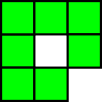
A lot of creativity is mixing existing ideas in ways nobody else has yet thought to mix them. That’s much of what I try to do in recreational mathematics in general, but in polyform tilings there is a more literal sense of mixing: combining different types of shapes within the same tiling. Previously I tried mixing different symmetry variants of polyominoes. With flexible polyforms, we can mix polyforms with entirely different base cells, since distorting angles can allow them to become compatible. Here is a tiling of flexible pentominoes together with the hexiamonds:

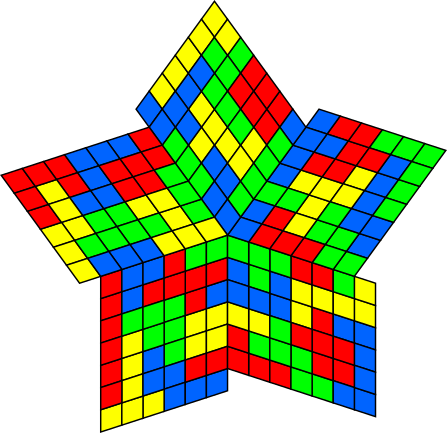
Another creative tool is tweaking magnitudes of qualities. We can turn one negative, and ask what it’s opposite might mean, or what happens if we reverse a process. Or we can tweak a knob the other way toward an extreme. We already do that with flexible polyforms when we ask, “Can we get more symmetry by squeezing more repeated segments around the center?” We can also ask, “What would it mean to make flexible polyominoes even more flexible?” Here’s one answer:

As it happens, my motivation for finding this was seeking a different extreme. I wanted to find the “best” possible shape to tile with flexible polyominoes. There is no clear definition for “best” here. More symmetry is nice, but so is convexity and a smooth border. Regular polygons seem good if you can pull them off. (Previously, we managed to squeeze the hexiamonds into an octagon.) So I started with a regular pentagon, and looked for a good way to subdivide it into 60 cells, and ended up with the scheme used above.

And with that coda, I conclude my series on flexible polyominoes. I’m sure there is much more out there to be found, but for now I’ll be searching elsewhere for new and fun ideas.

Rescued by Flexible Polyominoes

See the previous Flexible Polyomino post here.

One unfortunate lesson that you quickly learn about tiling problems involving a full set of (free) n-ominoes is that the pentominoes are the only really nice set. Monominoes through trominoes are trivial. And tetrominoes and hexominoes have checkerboard parity problems. Here’s an example. Suppose we wanted to tile a figure containing five copies of a 6×7 rectangle with the hexominoes. (It might be a 30×7 rectangle, or a 35×6 rectangle, or something more fanciful.)

These rectangles (suitably checkered) have an odd number of both black and white squares, and since an odd times an odd is odd, so do five of them. But 11 hexominoes are “even” (they will always cover an even number of both black and white squares) while 24 are odd (they cover an odd number of squares of each color.) Since an even number times an odd number must be even, there must be an even number of squares of both colors in both the even and odd hexomino subsets, and thus also in the full set. So our figure is impossible to tile.

But flexible polyominoes come to our rescue. This figure, formed from five of the above rectangles with a little distortion, can be tiled with hexominoes!

Why does it work? Well, consider what it would mean to checker the underlying cells. There is a cycle of five cells around the center. If you color one of the cells white, then as you go around the center, the next cells would be black, then white, then black, then white again. But the following cell would be the one where we started, and it would have to be black! So you can see that whenever we have an odd cycle of cells, we can’t have a consistent 2-coloring, and the checkerboard parity argument above no longer applies.

Note that there’s no magical property of flexible polyominoes involved here, just the presence of an odd cycle. The following figure has no odd cycle, so checkerboard parity applies, and it turns out to be untileable with the hexominoes.

Checkerboard parity problems can only occur with sets of even-sized polyforms. Our next odd size is the heptominoes, but here a new problem emerges. One of the heptominoes has a hole:

Thus every heptomino tiling must either incorporate a hole or omit the holey heptomino. Either solution is inelegant. Flexible polyominoes rescue us once again!

Solution by Edo Timmermans

The holey heptomino is there, but the hole is not. Can you find it?

Once you move to the octominoes and beyond, “opening” a holey polyomino can require breaking a connection between cells, so we’ll stop here. But the 9-iamonds, like the heptominoes, have a single holey piece where the hole is pinched together with disconnected “fingers”.

Problem 54: Tile this figure with the flexible 9-iamonds. There are 160 9-iamonds, which brings us into the zone where we’d want a pretty efficient solver in order to make headway.

This gets us through most of the 2022 Flexible Polyform Renaissance material that I wanted to post, but there is still enough for a brief coda, which I hope to complete soon.

Revenge of Flexible Polyominoes

Several months ago, I felt myself at a bit of a creative ebb. I wasn’t coming up with any bold new polyform ideas, so the best I could do would be to tinker around in a space that was already well-trodden. In this state of mind, I asked myself: did Abaroth miss anything good?

When I came up with the idea of letting the cells in polyominoes be flexible rhombi, Abaroth ran with it, and made an entire gallery of tilable shapes with solutions. Some of Abaroth’s discoveries used rows of squares as seams between the “leaves” of a target shape, but he missed this nice pentomino star:

An obvious thing to want after seeing a tiling like this with five-fold dihedral symmetry is one with sixfold dihedral symmetry. So far, the attempts have run into some problems.

The tiling on the left is Abaroth’s. It contains a couple of ambiguous pentominoes in the upper right. Where the green one wraps around a degree-3 vertex, it could be “unglued” to form either an X or an F pentomino. The red one could be an L, an N, or a Y.

The tiling on the right is mine, and has a different problem. The P pentomino in the upper left is not ambiguous, but it is split. This type of flaw can only occur in a polyomino that contains a square tetromino; P is the only pentomino that does.

Problem #53: Find a flexible pentomino tiling with sixfold dihedral symmetry without ambiguous or split pentominoes.

One-sided flexible polyominoes were another area that had been missed. It turns out that there are some nice tilings here:

George Sicherman, Abaroth, and Edo Timmermans all found one-sided pentomino tilings for the above double star. This double balanced three-coloring found by Edo Timmermans is particularly nice. Remarkably, the one-sided hexominoes also admit a double star:

(Solution again by Edo Timmermans.)

It might not be clear at first that other symmetry variations on polyominoes will survive in this weird flexible world, but in fact some can. If squares can flex into rhombi, then rectangles can flex into parallelograms, and we can get tilings like the following, using the 3-, 4-, and 5-rects:

For the second post in a row, I’m going to stop with at least another post’s worth of material left to share. If I leave you in suspense, you’ll have to keep coming back, right?

Flexible pentominoes on rhombic polyhedra

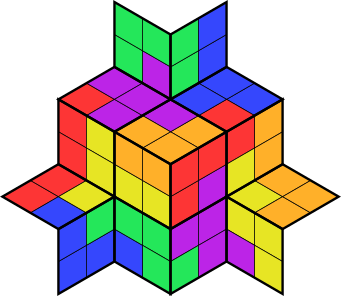
If you subdivide the faces of a rhombic triacontahedron into 2×2 grids, you can tile the polyhedron with two copies of each pentomino.

One way of looking at this figure is as a tiling of the projective hemi-rhombic triacontahedron. The projective (also known as abstract) polyhedra can be formed by identifying the opposite faces of certain polyhedra with each other. So the projective hemi-cube has three square faces, and the projective hemi-rhombic triacontahedron has 15 rhombic faces. Stitching together the opposite sides of the unshaded area in the figure is a way to form this 15 face “polyhedron”.

I came up with that one a couple of years ago, but I neglected to put up a blog post because I didn’t like the graphic enough. I suspect that it’d look really cool if the lines of the rhombic triacontahedron were properly projected onto a flat disk, but I don’t have the expertise to make that happen. I finally decided that it was worth sharing even if it doesn’t look as cool as it could.

Below is another tiling of subdivided rhombi. The significance of this figure is that four copies could be used to cover a rhombic hexecontahedron.

Stop! In the name of Octagons!

In the spirit of the flexible rhombic cell polyominoes that I posted about previously, here’s a hexiamond tiling of eight triangular segments squashed into an octagon:

hexiamonds in an octagon

Of course, octagons can also be used as base cells for polyforms. In fact, any regular polygon (and quite a lot of other things) can be used in this way, but octagons are special. They don’t tessellate the plane by themselves like equilateral triangles, squares, and hexagons, but they do form a semi-regular tessellation of the plane along with squares. This makes polyocts behave fairly well; you won’t be able to tile something convex and hole-free with them, but you can tile something that’s reasonably symmetrical at least. For example, here’s a tiling of the 1-, 2-, 3-, and 4-octs:

polyocts-2

That’s not the most symmetry that polyocts are capable of, (full octagonal symmetry is possible) but it’s the most we’re going to get with this set of pieces. See this page by George Sicherman for some figures with full symmetry that can be tiled with various individual polyocts.

Flexible polyrhombs

From time to time, a pentomino tiling still manages to surprise me.

pentomino tiling with 5-fold dihedral symmetry

Normally, the largest number of symmetries you can make a pentomino tiling have is eight, the number of symmetries of the square. For example, we can tile an 8×8 square with the corner cells removed. (If we leave the plane for other topologies like cylinders and tori we can get more.) However, it’s a basic principle of flexible polyform tilings that we can generally try to squeeze one more repeated unit around the center of a rotationally symmetric tiling. So I did.

But my starting point for this was not the pentominoes. In my Hinged Polyform post, I discussed polyforms where the connections between pieces could occur at arbitrary angles. Conversely, we could look at polyforms where the shapes of the individual cells could contain arbitrary angles. If we assume that all of the edges are the same length, there is only one possible triangle, so polyiamonds in this scheme aren’t interesting. Rhombuses are the simplest example of cells where the angles can vary. Since they have only one degree of freedom per cell, they are reasonably tractable. The flexible tetrarhombs include flexible versions of the five tetrominoes in addition to the three shapes in blue below:

pentaflexirhombs

The flexible pentarhombs include the flexible pentominoes, the 18 forms that can be derived by adding a single red cell to one of the blue forms above, and the six additional forms in green. (I may well have missed some.)

It may be possible to find a good flexible tetrarhomb tiling, but I haven’t yet managed it. And 36 pentarhombs is too many for me to handle. If only there were some subset with a better number of pieces for a puzzle, something like the 12 pentominoes.

Oh. Right. (And that was more or less the thought process that led to the tiling above.)

Hinged Polyforms

Here’s a tiling of the nine hinged tetriamonds:

hinge-iamond-2

Hinged polyforms meet at corners rather than edges as in regular polyforms. The corner connections, like hinges, are flexible: two hinged polyforms are equivalent if it is possible to turn one into the other by swinging the hinges at the vertices, in addition to rotating and reflecting the whole pieces. Hinge angles that cause two cells to lie flat against each other are disallowed, as it isn’t possible to visually distinguish which side of the edge has the hinge. In some cases, hinges may be “locked”, with angles that are completely determined by the geometry of the piece. (For instance, when three cells meet around an equilateral triangle.)

With the above piece set, it is possible to realize all of the pieces using a small set of angles for the individual triangles. Other sets may be trickier to work with.

Here are the hinged tetrominoes:

hinge-4-ominoes

Can a symmetrical tiling be found for these? Problem #43: Find one.

Constellations

I made a presentation on flexible polyforms at the last Gathering for Gardner, but there were some polyform types that I didn’t get to, since I hadn’t yet come up with any good problems for them. One odd sort of polyform, which I am fancifully calling a constellation, can be obtained from configurations of points on the plane. We can consider two sets of points on the plane to be distinct if the pattern of collinearity among the points is different. Because every pair of points defines a line, the lines with only two points are, in a sense, not interesting; only the lines with three or more points need to be considered when determining whether two constellations differ. It seems reasonable to consider the order of points on a line to be significant; this gives us three different 5-point constellations with a pair of three point lines that meet at a point. There are 7 5-point constellations in all. Here’s the first tiling puzzle solution I found for them:

constellation-5-5

One rule for constellation tiling puzzles that I like is to disallow any point from one constellation from falling directly between two points in another constellation. This keeps the constellations more compact, and adds a little challenge to the puzzle. I like to get as much symmetry as possible in one of these flexible polyform tilings, so I decided to try for one with 7-fold symmetry. This was a little harder, but eventually I found the following tiling:

April 2018: Edited to update the image to a proper solution. Thanks to Bryce Herdt for noticing that the old solution was incorrect.

Where can we go from here? If I’ve counted right, there are 21 6-constellations. Of these, 7 can be formed by adding one independent point (a point on no line of 3) to each of the 5-constellations. The full set seems a little too big to solve by hand, but if we exclude the ones with independent points, a puzzle with the remaining 14 seems more manageable. (We may also want to exclude the 6-constellation with two separate lines of three points. With that one excluded, the remaining 13 6-constellations all can be formed from connected groups of lines with 3 or more points.)
constellation-6-set

The 14 6-constellations with no independent points.

Problem #42: Find a tiling of 6-constellations with 6-fold dihedral symmetry. Either the set of 13 or the set of 14 will do. Even more symmetry is even better.

Polycircles

A while back, (before I started this blog) I was exploring polyforms using unit-radius circles as their base cell type, which I called “polypennies”. We can think of these as “flexible” polyforms: since connections between the circles can occur at arbitrary angles, we consider two polypennies to be equivalent if we can continuously move the circles around each other without changing which circles are adjacent. (As with other polyform types, rotations and reflections are also considered equivalent.)

The pentapennies

I called these polyforms “polypennies” rather than “polycircles” because “pennies” captured the equal size of the cells. (ETA: I forgot that I raided the word from the term “penny graph,” which has been used as an alternative to “unit coin graph” to describe the adjacency graph associated with a particular configuration of non-overlapping unit radius circles.) I also knew that eventually I would want to get to polyforms made of circles of arbitrary size, for which I was reserving the term “polycircle”. Well, it happens that I’ve been invited to Gathering for Gardner 10, where I plan to give a talk on flexible polyforms, so eventually is now.

For polycircles with cells of arbitrary size, another dimension of flexibility is required. Two polycircles are equivalent if they can be made congruent by continuously expanding or shrinking the circles without changing adjacencies, in addition to applying the transformations allowed with polypennies. This extra flexibility means that, in addition to the polycircles that are equivalent to polypennies, there are some polycircles that could only be formed by placing circles into spaces where they wouldn’t fit if all of the circles were forced to be the same size.

As with other flexible polyforms, elegant tiling puzzles for the polycircles can be produced by attempting to maximize the symmetry of the configuration to be tiled. Here’s an example, with fourfold rotational symmetry, of a tiling puzzle containing all of the polycircles of order 1 through 4:

This was not a hard puzzle to solve, once I came up with a configuration to tile that would work. Adding smaller pieces is a time-honored trick for making polyform puzzles easier; I put in the 1- through 3-circles because I was failing to make any headway with the 4-circles alone. The extra dimension of flexibility was helpful in that one can generally resize the circles to touch more neighbors than is possible in polypenny puzzles, which tend to end up with a number of cells with only two neighbors. On the other hand, the 4-circles with a circle inside the gap between three others in a triangle were trickier to deal with than any of the 4-circles that are equivalent to 4-pennies.

Can we do better than the above? I think fivefold symmetry may be possible.

Problem #26: Find and solve a tiling puzzle for the 1-, 2-, 3-, and 4-circles with fivefold rotational symmetry.