
Marking external edges of polyforms leads naturally to restrictions on tilings that make for good puzzles. We can simply match marked edges, and if two edges on each piece are marked, we can draw a path between them and make challenges based on properties of the paths formed. Internal cell edges on pieces can also be marked. Since there isn’t a “natural” challenge using these markings, we’ll have to be creative. Here’s a tiling of all 12 ways to mark a single internal edge in a 5-iamond, where the markings have reflection symmetry:

Ah, symmetry, the first resort of the lazy polyform problemist. More symmetry is always better, so that’s Problem #65: Find a tiling of the above figure with the same pieces, where the edge markings have 3-fold rotation symmetry.
There are 10 ways to mark an internal edge in a 4-omino. The challenge that I’ve devised is to place the pieces so that no edge mark is on the same line as an empty internal edge. One of the pieces, the marked square tetromino, inherently breaks this constraint. So, by the law of exclusion of inconvenient pieces, it has to go.

Excluding the inconvenient piece lets us tile a square, giving us a little extra symmetry compared to the rectangle we would have otherwise been forced to tile.
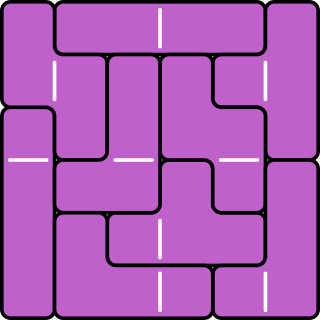
If inconvenient piece exclusion is the first step toward becoming a dirty puzzle designer instead of a pure and noble recreational mathematician, surely the extra symmetry will stand as penitence for my sin.
