Rescued by Flexible Polyominoes

See the previous Flexible Polyomino post here.

One unfortunate lesson that you quickly learn about tiling problems involving a full set of (free) n-ominoes is that the pentominoes are the only really nice set. Monominoes through trominoes are trivial. And tetrominoes and hexominoes have checkerboard parity problems. Here’s an example. Suppose we wanted to tile a figure containing five copies of a 6×7 rectangle with the hexominoes. (It might be a 30×7 rectangle, or a 35×6 rectangle, or something more fanciful.)

These rectangles (suitably checkered) have an odd number of both black and white squares, and since an odd times an odd is odd, so do five of them. But 11 hexominoes are “even” (they will always cover an even number of both black and white squares) while 24 are odd (they cover an odd number of squares of each color.) Since an even number times an odd number must be even, there must be an even number of squares of both colors in both the even and odd hexomino subsets, and thus also in the full set. So our figure is impossible to tile.

But flexible polyominoes come to our rescue. This figure, formed from five of the above rectangles with a little distortion, can be tiled with hexominoes!
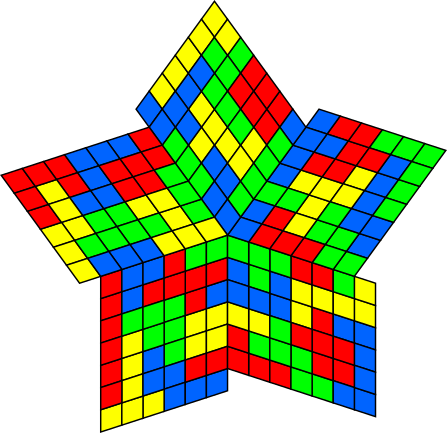
Why does it work? Well, consider what it would mean to checker the underlying cells. There is a cycle of five cells around the center. If you color one of the cells white, then as you go around the center, the next cells would be black, then white, then black, then white again. But the following cell would be the one where we started, and it would have to be black! So you can see that whenever we have an odd cycle of cells, we can’t have a consistent 2-coloring, and the checkerboard parity argument above no longer applies.

Note that there’s no magical property of flexible polyominoes involved here, just the presence of an odd cycle. The following figure has no odd cycle, so checkerboard parity applies, and it turns out to be untileable with the hexominoes.

Checkerboard parity problems can only occur with sets of even-sized polyforms. Our next odd size is the heptominoes, but here a new problem emerges. One of the heptominoes has a hole:
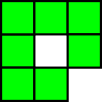
Thus every heptomino tiling must either incorporate a hole or omit the holey heptomino. Either solution is inelegant. Flexible polyominoes rescue us once again!

Solution by Edo Timmermans

The holey heptomino is there, but the hole is not. Can you find it?

Once you move to the octominoes and beyond, “opening” a holey polyomino can require breaking a connection between cells, so we’ll stop here. But the 9-iamonds, like the heptominoes, have a single holey piece where the hole is pinched together with disconnected “fingers”.

Problem 54: Tile this figure with the flexible 9-iamonds. There are 160 9-iamonds, which brings us into the zone where we’d want a pretty efficient solver in order to make headway.

This gets us through most of the 2022 Flexible Polyform Renaissance material that I wanted to post, but there is still enough for a brief coda, which I hope to complete soon.

Revenge of Flexible Polyominoes

Several months ago, I felt myself at a bit of a creative ebb. I wasn’t coming up with any bold new polyform ideas, so the best I could do would be to tinker around in a space that was already well-trodden. In this state of mind, I asked myself: did Abaroth miss anything good?

When I came up with the idea of letting the cells in polyominoes be flexible rhombi, Abaroth ran with it, and made an entire gallery of tilable shapes with solutions. Some of Abaroth’s discoveries used rows of squares as seams between the “leaves” of a target shape, but he missed this nice pentomino star:

An obvious thing to want after seeing a tiling like this with five-fold dihedral symmetry is one with sixfold dihedral symmetry. So far, the attempts have run into some problems.

The tiling on the left is Abaroth’s. It contains a couple of ambiguous pentominoes in the upper right. Where the green one wraps around a degree-3 vertex, it could be “unglued” to form either an X or an F pentomino. The red one could be an L, an N, or a Y.

The tiling on the right is mine, and has a different problem. The P pentomino in the upper left is not ambiguous, but it is split. This type of flaw can only occur in a polyomino that contains a square tetromino; P is the only pentomino that does.

Problem #53: Find a flexible pentomino tiling with sixfold dihedral symmetry without ambiguous or split pentominoes.

One-sided flexible polyominoes were another area that had been missed. It turns out that there are some nice tilings here:

George Sicherman, Abaroth, and Edo Timmermans all found one-sided pentomino tilings for the above double star. This double balanced three-coloring found by Edo Timmermans is particularly nice. Remarkably, the one-sided hexominoes also admit a double star:

(Solution again by Edo Timmermans.)

It might not be clear at first that other symmetry variations on polyominoes will survive in this weird flexible world, but in fact some can. If squares can flex into rhombi, then rectangles can flex into parallelograms, and we can get tilings like the following, using the 3-, 4-, and 5-rects:

For the second post in a row, I’m going to stop with at least another post’s worth of material left to share. If I leave you in suspense, you’ll have to keep coming back, right?

Flexible pentominoes on rhombic polyhedra

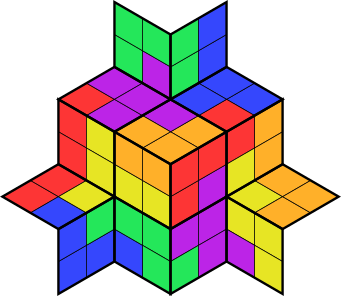
If you subdivide the faces of a rhombic triacontahedron into 2×2 grids, you can tile the polyhedron with two copies of each pentomino.

One way of looking at this figure is as a tiling of the projective hemi-rhombic triacontahedron. The projective (also known as abstract) polyhedra can be formed by identifying the opposite faces of certain polyhedra with each other. So the projective hemi-cube has three square faces, and the projective hemi-rhombic triacontahedron has 15 rhombic faces. Stitching together the opposite sides of the unshaded area in the figure is a way to form this 15 face “polyhedron”.

I came up with that one a couple of years ago, but I neglected to put up a blog post because I didn’t like the graphic enough. I suspect that it’d look really cool if the lines of the rhombic triacontahedron were properly projected onto a flat disk, but I don’t have the expertise to make that happen. I finally decided that it was worth sharing even if it doesn’t look as cool as it could.

Below is another tiling of subdivided rhombi. The significance of this figure is that four copies could be used to cover a rhombic hexecontahedron.

Some Contributed Solutions

I’ve had a few solutions sent in recently, so I wanted to share them with you all.

First, Abaroth noticed that my rhombic-cell pentomino tiling had just enough space to fill out into a five pointed star if the tetrominoes were also included:

tetra-penta-star

But that was just the beginning! He then proceeded to produce an entire collection of tilings with these pieces, which he calls flexominoes. One problem that can come up in tilings of this sort is that if there is a vertex with three rhombi around it, a polyomino containing all three rhombi has an ambiguous identity, since there is more than one way to “unglue” the polyomino at that point. I contributed an ambiguity-free solution to one of the patterns Abaroth found:

flexomino-8-star

Speaking of rhombuses, Abaroth has been investigating color-matching puzzles using rhombic tiles. His puzzle page has more interesting material on color matching puzzles and symmetrical polyhex tilings.

Next up, George Sicherman sent in a symmetrical tiling for the flexible tetrarhombs:

tetrarhomb-gs-sol

What’s interesting here is that although the outline of the tiling is symmetrical, the pattern of the cells isn’t. The lesson here is that being able to trade off some cell-level symmetry for more pattern-outline symmetry can give us a little variety in our choices of what we can tile.

Finally, Bryce Herdt provided a de Bruijn sequence of invertible length 5 binary words. (That is, a cyclic sequence where each word occurs once as a substring.) Since he did so in text format, I made a visualization:

debruijn-invert