Notation Notions: Addition Addendum

1.

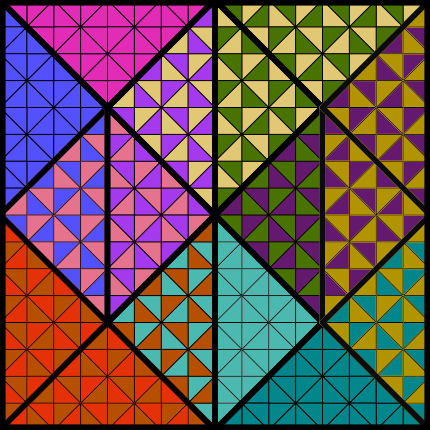
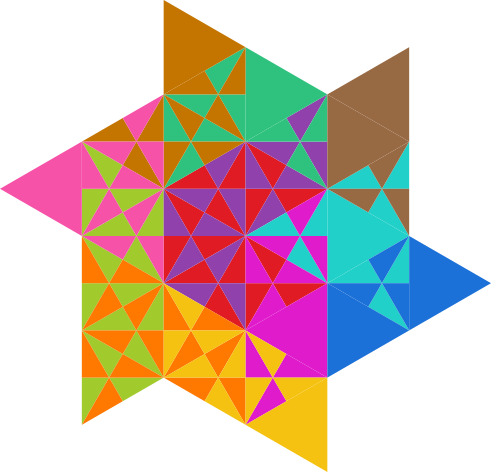
Previously, we looked at what we might mean by such things as “The 3+2-ominoes”, and distilled the beginning of a notation system from that. But before we get very far, we might find some instances where our polyform set addition notation is unsatisfactory. Here are the 2+1+1-ominoes, or 2+1+1■ for short:

It strikes me as I look at these that sometimes I might want to be able to refer to a set that works like just the top row of these. “I want a domino, with a couple of monominoes attached directly to it. Show me all of the ways to do that!” For this, we’ll need a new operator, which I’ll write with a colon and call the with operator. We can now call the top row set 2:(2⊙1)■, or “domino with two monominoes” spoken informallly.

2.

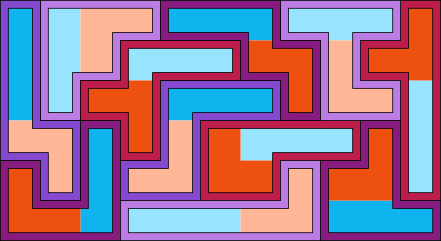
A variation we might want for n+n-forms is to exclude compound forms containing repeats of the same part. For example, in Problem #59, we looked at a component coloring problem involving heterogeneous ditrominoes. We can coöpt “choose” notation, \({S \choose k}\) to give us all of the ways to attach k forms from the polyform set S. Thus we could write the heterogenous ditrominoes as \({3■ \choose 2}\).

As it happens, Bryce Herdt recently solved problem #59. I had shown a component 4-coloring where the L3’s could take two different colors and the I3’s could take the other two colors. (L3 and I3 are the standard abbreviations for the L tromino and the straight tromino.) The problem was to make the 4-coloring strict. Herdt not only succeeded in this, but the 4 possible combinations of colors in a ditromino also make a strict 4-coloring. I have identified each of these color combinations with an outer border color in the diagram below in order to highlight this second 4-coloring.

In this case, another way to notate the same set would be L3+I3. Of course, we aren’t defining addition on polyforms themselves, but rather polyform (multi)sets. So let us use the notational convention that italicizing a polyomino abbreviation gives us the set with just that polyomino as a member. (As only polyominoes have standard single letter names, the “■” can be omitted.)

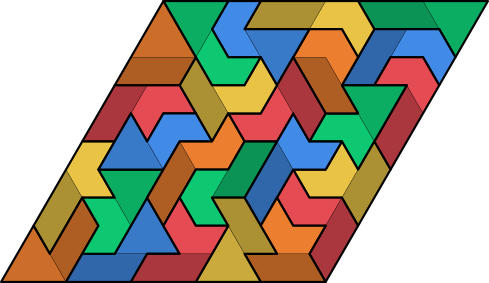
For another example, here are the 25 heterogeneous di-tetriamonds, or \({4▲ \choose 2}\). Since the number of cells is twice a square, they can tile a rhombus of edge length 10.

I still have more entries in this series planned. A comprehensive system of polyform set notation may never be able to describe every set of polyforms we might encounter, but to the extent that it can make exploring and keeping track of polyform sets easier, it does seem like a worthy goal.

Notation Notions: Operations on Ominoes

Here’s a tiling of the 3+2-ominoes:

This use of a plus sign seems natural enough, but we might want to think a bit more about what it implies. We have established an operation on polyform sets, and a notation for that operation. This raises some questions: what other operations might we want to use? How should we notate them? And finally, can we design a notation system that readably describes a wide variety of polyform sets? (And should we?)

After addition, a notation for multiplication would be handy. We’ve recently looked at di-triamonds and tri-diamonds. We can call these 2·3-iamonds and 3·2-iamonds respectively. Notice that this multiplication, unlike the addition, doesn’t commute. But it does decompose into addition in the natural way; the 3·2-iamonds are the same as the 2+2+2-iamonds.

In a way, we were already using polyform multiplication to define n-forms in the first place. The pentominoes are essentially the 5·monominoes. In the interest of brevity, we can use symbols for common base monoforms:▲, ■, ⬣, and ◣ for the moniamond, monomino, monohex and monotan respectively. If we are consistent with the above examples, a n■ has subdivisions for the individual cells. That may seem a little weird, but it can be useful; a 2×1 rectangle could be either a domino or a tetratan, and we’d like to be able to know which. I won’t show these subdivisions in my graphics unless it aids with clarity.

We would also like to combine sets together into a larger one. This is multiset addition rather than set union, because we could want to work with multiple copies of the same polyform. I’ll use circled operator symbols for multiset operations, even though that’s a little nonstandard. They’re nicely readable, and the circle will be our mnemonic that we’re doing multiset things. The tetrominoes and pentominoes together would be 4⊕5■. We can read the ‘⊕’ as “and”, so 4⊕5■ is read as “the four and five -ominoes”. Making a set from multiple copies of the same set is the same as scalar multiset multiplication. So five copies of the tetrominoes is 5⊙4■. As before, this is non-commutative left multiplication; the dot is our mnemonic for that. And it decomposes as expected into multiset addition: 5⊙4■ = 4⊕4⊕4⊕4⊕4■. I can’t think of any reason I would ever want to do element-wise multiset multiplication with polyforms, but ⊗ is there if I ever need it.

Now that we have multiset operations and polyform connection operations, we can start to combine them. There are 22 4+1■. I hope to share more problems involving them soon, but one thing I noticed was that with some smaller pieces included I could get an area of 144, and make a square. With my notation system, I can call these 2+1⊕3+1⊕4+1■. Or I could write that as (2⊕3⊕4)+1■. Polyform addition distributes over multiset operations!

(Well, I could have made a square. I’m showing this shape instead because PolySolver wasn’t finding solutions for the square with separated monominoes. Thanks to Bryce Herdt for showing me a technique for getting PolySolver to find solutions with this property.)

Finally, I must address the final question from the start of this post. Is a notation system for polyform sets actually a reasonable thing to develop, given that I am a lone crank and nobody else is likely to use this stuff? And I think that I am finding, for my own explorations with polyforms, that the answer is yes. With algebraic notation, the concepts behind the notation can be expressed with words, and were for a long time. But symbols are easier to mentally manipulate, and formulas that could not fit into working memory as a paragraph can do so as a modest number of symbols. I am already finding it easier to think about polyform sets because I have symbolic notation for them. As I hinted in my fuzzy polyominoes post, I’m working on notation for related concepts, so more posts on polyform notation are sure to follow.