The loan seemed like an incredible break. You got back on top of your mortgage, even had enough to put your oldest into a decent private school. And all they asked you to do was solve puzzles.
The puzzles were actually fun, for a while. But they got harder. And when you couldn’t solve them fast enough, the threats started. And that’s how you ended up here, wherever here is, kidnapped, bruised and bloody, on a floor covered with grit and sharp angular tesserae.
There’s a note. Another puzzle. In order to leave, you’re going to have to pick out some of the tesserae and use them to tile a shape. And no two tiles of the same color may touch. Pretty basic.
And then you realize that it’s too dark for you to be sure what the colors of the tiles are.
There’s a real problem with constraining the number of colors in a colored tiling as an additional challenge: our options just aren’t very granular. Literally everything (on a plane, which sometimes we aren’t!) can be 4-colored, a small proportion of things can be 3-colored, and almost nothing that isn’t highly contrived can be 2-colored. If only there were some options in between!
To our relief, and our hero’s consternation, there can be. Observe that we can make a graph with colors as nodes and edges connecting colors that are permitted to touch. For an n-coloring, this is simply the complete graph Kn. But there might be other graphs (we’ll call them color graphs) that produce interesting results. For example, consider this one:
We might consider one color graph to have greater “coloring power” than another if it can be used to color a proper superset of the graphs that the second graph can color. This graph turns out to have a coloring power intermediate between those of K2 and K3.
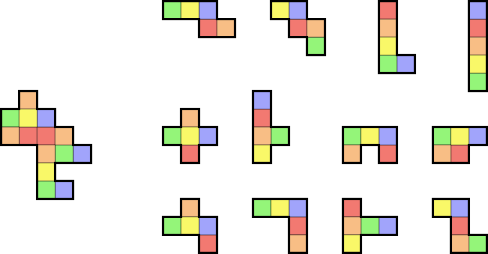
Here’s a tiling of the 2–5-iamonds colored according to the above graph. (Kadon sells these shapes as its Mini-Iamond Ring puzzle.)
There’s a reason I showed the color graph as a pentagram, even though you could rearrange the nodes into a pentagon and get rid of the crossings. Let’s take a simplified model of color where allowed instances lie on a circle of hues. From the perspective of our hero with color vision reduced by darkness, nearby colors around the circle might be too similar to safely place next to each other.
As we raise or lower the level of light in this dungeon, the minimum distance between colors that can be allowed to be adjacent in a coloring will change. We can make arcs along the circle that correspond to hues that can be legally adjusted to the hue at the center of the arc. Finally, we connect the nodes for the arcs that don’t overlap to make a color graph.
For arc lengths (as a proportion to the circumference of the circle) that are fractions of the form 1/n, we get the complete graph, Kn. But for other rational arc lengths, we get different graphs. Here’s the one for an arc length of 2/5:
What’s nice here is that the reciprocal of the arc length describes the coloring power of the corresponding graph. For the above graph, the reciprocal is 2½, and this does in fact mean that its coloring power is stronger than 2-coloring and weaker than 3-coloring. This type of coloring is called a “circular coloring“, and it extends our usual definition of chromatic numbers into “circular chromatic numbers”. The graphs that are formed by this process are “circular complete graphs”.
Here’s the color graph for a circular chromatic number of 7/2:
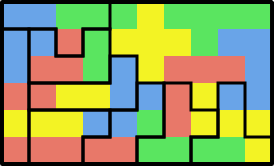
This one can also be useful for coloring polyform tilings. Consider this tiling of the 21 5-rects:
It is not 3-colorable, as we can see by starting at the starred pieces and following the colors that are forced until we come to the checkered yellow pieces. But it is “7/2 colorable”!
One nice aspect of this coloring scheme is that we can get balanced colorings of sets that have a multiple of seven pieces. There are undoubtedly balanced 3-colorable solutions to the above tiling problem however, so this isn’t necessarily the “best” coloring possible here. A solution to the following problem might have a good claim to the title though: Problem #57: Find a tiling of the above figure with the 5-rects that has a 3-coloring and a 7/2-coloring such that all 21 color combinations occur exactly once.
Now, you may be grumbling at this point about my title being inaccurate and click-baity, because there are clearly seven different colors here, not three and a half. And certainly, there are for you and I, who have plenty of light to see them by. But for the poor soul toiling with ambiguously colored pieces in my basement some entirely hypothetical dungeon, it really does feel like having somewhere between three and four colors available.
This is just the beginning of a rabbit-hole that can go a lot deeper than this blog post can contain. A curious person might wonder: what about other color graphs? Playing around a bit shows that a lot of different color graphs have the same “coloring power”. For example, any even cycle graph can color exactly the same graphs as K2. If you number the nodes around the cycle, even colors may only be adjacent to odd colors, (and odds to evens) and the even and odd sets of colors can color exactly the graphs that the 2 nodes of K2 can color.
In more standard mathematical terms, what the last paragraph says is that even cycle graphs are homomorphic to K2. Generally, homomorphically equivalent color graphs have the same coloring power. Every graph is homomorphically equivalent to a so called “core”, a minimal graph that captures the information we need for coloring. (In the previous example, K2 was the core.) So we can restrict ourselves to just cores when we’re looking for interesting color graphs.
The circular complete graphs we looked at are cores. Other cores exist, but they don’t fit nicely into the ordering that the circular complete graphs do, and so don’t give us meaningful chromatic numbers. But they could still be fun things to apply to polyform colorings. (Or even problems of actual mathematical import. In 2018, the lower bound of the Chromatic Number of the Plane was improved to 5. Perhaps a unit distance graph with a circular chromatic number of 11/2 could be found, effectively improving the lower bound for an extended version of the problem.)
And that’s all I have for now, although I expect that this won’t be the last time I visit the subject of colorings. Until next time, be well, and beware loan sharks bearing puzzles.