Fractional Tans, Part 1: Glom

I left polytans out of my post about polyforms with fractional weight cells. They behave a little weirdly, and deserved their own post. Which is this one! But first, a notation consideration. Previously, I made the distinction between glom polytans, where tans can be placed in arbitrary orientation as they are glommed onto another tan, and grid polytans, where tans are constrained to the tetrakis square grid. Both of these polytan types seem important enough for my notation system to capture. Luckily, Unicode provides us with more than one right triangle. So, we’ll give the glom polytans “◣”, because that triangle stands to the left, and let the grid polytans have “◢”, which stands to the right.

That out of the way, we’ll focus on glom polytans in the current post. When I described how to make polyforms from fractional weight cells, I allowed the cells to stack entirely on top of other cells as well as to be placed adjacent to other cells. With polytans, there is another possibility. Here are the pieces that I consider to properly constitute 3·½◣:

Above, areas where two half-tans overlap are shown in a darker shade. The first two rows contain well behaved pieces, but in the third row, there are half-tans with partial overlap. We can make these by loosening our rule of how glomming works. It becomes:

  1. Select an edge of a cell.
  2. Place another cell on either side of that edge such that an edge of the new cell entirely coincides with the selected edge, and at no point does the entire weight of cells present exceed 1.

I’ll grant that n·½◣ tans containing partial overlaps look a little weird, and one could reasonably choose to exclude them. I have chosen not to do so in part because if you start with a larger set you can make a subset with desired properties by filtering out undesirables, but if you start with the smaller one, you can’t recover the larger. Anyway, 12 3·½◣ have enough area·weight to fill a 3×3 square. Bryce Herdt found this piling:

If the pieces with partially overlapping tans are removed, the remaining 3·½◣ have area·weight 6, but throwing in the three 2·½◣ restores our ability to fill a square. Here’s a {2,3}·½◣ piling of a 2√2×2√2 square:
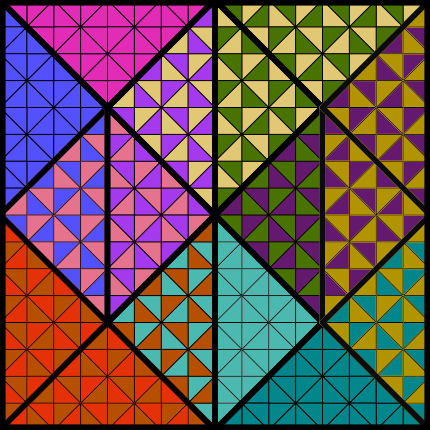
A non-trivial tiling problem in a 3×3 square may have seemed unlikely enough, but leave it to the fractional tans to inhabit one in an even smaller square! As the title of this post suggests, I intend to write another post about fractional grid polytans sometime soon. I also have a bunch more to write about my notation scheme. Hopefully I can finish that off before the decade is out, but I might have to work on blogging more prolifically for that to happen.

Four Square Sequels

In planning out blog posts, I typically use the rule of thumb that a post should contain between two and four images. If I have five or more images, I try to break the material up into multiple posts, and if I have only one I will usually wait until I have more material. A single image is a still life; when there are more, I can tell a small story. Unfortunately, this means that over time I build up a number of “orphans”, perfectly good results left to gather dust because I have nothing else that is closely related. I recently noticed that several of my orphans were square shaped. Perhaps I could use this to tie some disparate results that normally wouldn’t belong together into the same post.


1) I noticed last year that the tetrakis grid 4- and 5-tans had a combined area that could make a square. This seemed like a pretty basic result that had to have been known years before. I asked (and looked) around, but I couldn’t find any instances of it being found previously. Then in preparing this post, I discovered that I was almost right. It had, in fact, been found months before, by Thimo Rosenkranz. (That page isn’t visibly dated, but a timestamp in the html code indicates it was published in July of 2023.) For all I know, these pieces may have been studied many times previously, but having done the important step of preventing myself from falsely claiming primacy, I am content to leave off further historical research.

2) I claimed that I couldn’t do anything elegant with just the set of single-striped tetrominoes, but shortly after I posted that, I found the figure below. Here, I relaxed the rule that the stripes must form an unbroken line from one edge of a figure to another. Instead the stripes may have a singe-cell gap in order to allow a perpendicular stripe to pass through. A woven pattern, where each stripe crosses one other and allows another to cross it, seemed like the nicest possibility. (The faded dashed lines are artistic license on my part, not actual markings on the pieces.)

3) The pieces here are based on those in my L-Topia puzzle. That puzzle contained every way to mark two cells of an L tetromino with a circular and a square hole. When I had access to a laser cutter in 2009, I made a variation where, instead, the holes were double headed arrows that could point horizontally or vertically. I was recently reconsidering “pilings”, (tilings with overlap) and wondered what could be done with pieces with marking sites where the markings have two possible orientations by symmetry, and the overlaps must match one orientation with the other. My L-Topia variation came to mind, but I had better results with a similar variation, where the arrows would be diagonal instead. Here, instead of cutting out arrow-shaped holes, I cut out triangles on opposite corners, leaving a bar to overlap. There is a unique piling where the overlaps form a single loop joining all of the pieces.

4) At G4G15, I gave a talk on polykings and other polyomino variations where cells are connected in different ways from standard polyominoes. I based the talk on a couple of earlier blog posts, but I did throw in one additional result. One of my usual creative tricks is “mix ideas, even if they aren’t meant to be mixed.” In the context of tiling problems, that can work out to “tile with sets of pieces that aren’t meant to be mixed.” If we build the five tetrominoes with each of the five shortest cell connection types, we get 100 total cells. Why not throw them together into a 10×10 square? In the diagram below, each tetromino form is represented by a different color, while the crosses indicate the directions and magnitudes of the connection vectors.

Problem #64: Well, everything is always nicer if you can make things of the same kind not touch. Here that means both tetrominoes of the same form, and tetrominoes with the same connection type. But asking for both may be too much, so we may have to accept just one or the other. But wait! What exactly do we mean by not touching here? Simply using Wazirwise adjacency seems contrary to the spirit of the thing. Let us say that two pieces touch if the connection type of one of the pieces can reach, from one of its cells, a cell in the other piece.


We might like there to be some theme that we can tease out from these unrelated square tilings that can retroactively justify shoveling them into the same post. If there is, it might be parity of elegance. A square has high elegance, having maximal symmetry in a smooth, convex shell. But as a consequence of this elegance, we don’t have many sizes of squares available, just one for each integer, so we have to contrive somewhat inelegant sets of pieces to tile them. In the case of the striped tetrominoes, the fixed dimensions of the square forced me to fudge the stripe placement rules to get the stripes to fit.

Of course, there is no such thing as parity of elegance in the universe of possible tilings; many very inelegant tilings may be found. What we see is the effect of me selecting the most elegant tilings that I can find to share on my blog. In these cases, the elegance of the square justified less elegance in other aspects of the tilings.

Tantalized by Polytans

There are two fundamental methods for deriving a type of polyform. One is to begin with a tessellation, and consider connected subsets of that tessellation as its associated polyforms. The other is to begin with a single tile, and create instances of a polyform type by agglomeration of ever more copies to the starter tile. Regular polygon tiles do not allow us to distinguish between these methods. The triangle, square, and hexagon give us the same polyforms whether you use their planar tilings or accretion, and the other polygons do not tile the plane at all, and so admit only the latter method.

The tan, (a.k.a. isosceles right triangle) by contrast, does admit both methods in a way that gives us distinct sets of polytans for each. There are 3 different isohedral tilings of the plane with tans:

The first two are topologically equivalent to an equilateral triangle tiling, and polytans based on those tilings can be treated as equivalent to polyiamonds with restricted symmetry actions. But the last one, the tetrakis square tiling, does give us its own set of polyforms. George Sicherman has catalogued the tetrakis grid polytans. (Polytans are called polyaboloes there and in some other sources.) Since both tessellation and agglomeration methods give us reasonable polyform sets from the same base cell, pithier terms for each are desired, so I will go with “grid” and “glom” respectively. Due to the freer choices of orientations for tans, the glom n-tan sets grow much more quickly than the grid n-tans. Here are tilings of the 30 glom pentatans and the 8 grid pentatans:

The glom pentatans solution is from the Poly Pages.

A consideration for both grid and glom polytans is whether we choose to include all of the shapes with the same outline, but different internal divisions. If our only use for a set of shapes is to make a tiling, it may feel awkward to have extra copies of some of them. I fall on the side of preferring sets where all subtilings are present, because they may be relevant for problems other than tiling, and even tiling problems with additional challenges based on the subtilings. (I propose we use the terms “subtiled” and “unsubtiled” to distinguish the cases where different internal tile placements do and respectively do not give us distinct polyforms. There are other polyform types where this distinction is useful; consider polydominoes and polydiamonds.)

The pentatans in the above graphic are unsubtiled. In fact, for grid polytans up to size five, subtiling doesn’t give us extra pieces. But as we go up to hexatans, it does. Here’s a tiling of the subtiled grid tri-ditans:

Notice that there are two L tromino shaped pieces with the same first level subtiling into squares, but a different ultimate subtiling into tans, as well as two trapezoid shaped pieces with different first level subtilings, but the same ultimate subtiling. There is some subtlety in subtiling! [Edit: well, as pretty as that is, I missed a tri-ditan. There’s an S-shaped one with two big tans and a square in the middle. Darn.] [Later edit: okay, here’s the best I can do: use the 16 tri-ditans in the above figure to tile an inflated version of the missing one.]

There are 18 subtiled glom di-ditans, which, fortuitously, can tile a square. I set the additional challenge of finding such a tiling where there was symmetry in the orientations of the base tans. Bryce Herdt found this one:

Herdt reported that this appears to be the only one with this property upon a visual scan of all of the tiling solutions, but it’s possible another might have been missed.

I have, perhaps unjustly, ignored polytans before now. My first inclination when presented with a type of polyform is to ask, does this really give us any insights that we couldn’t have gotten from polyominoes or polyiamonds? When I found my first internet polyformist community in the Polyforms Yahoo group, there seemed to be quite a lot of exploration of new polyforms, and a lot less of new questions to ask about polyforms. So I focused on the latter, and mostly stuck with the most basic polyform types in order to keep to that path. But polytans really do give us important insights, and I hope to find and post about more of them in the future.