Fractional Tans, Part 2: Grid

As promised in Part 1, here’s a post on polyforms made from half-weight tans on the tetrakis square grid. The pieces with three and four of these collectively have weight·area 16, so we get to continue our run of square tilings. We can notate this set as {3, 4}·½ ◢. (This use of braces is a new addition to my notation, but is intuitive enough, I think.) Here are the pieces:

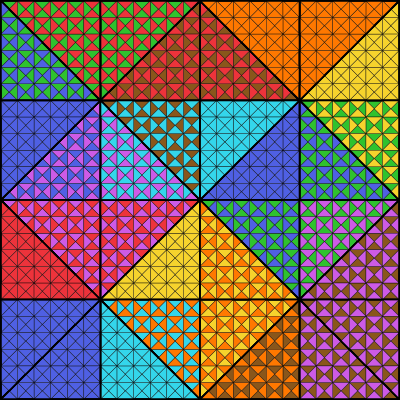
It can be challenging to pick the pieces out from this image of the 4×4 tiling, but they are all in here, I promise:
There are, in fact, two different n×n subgrids of the tetrakis square grid for even n. If we overlay the two subgrids as shown, we get a grid where all four orientations of a tan within a square cell are present:
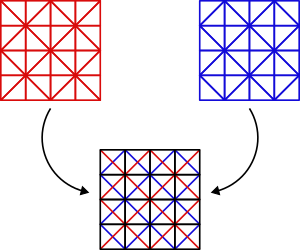
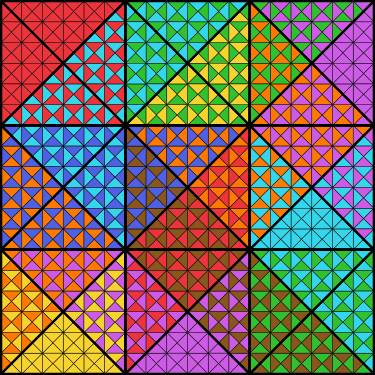
This grid (as extended to the plane) has the property of being “noble”, that is, all vertices and all tiles are equivalent. The tetrakis square grid itself is not noble, as there are two different kinds of vertices. (Even though this grid looks like a tetrakis grid, the points where diagonals intersect are not vertices.) The subset of the n·½ ◣ without any half-tans in coinciding positions will fit on the melded grid. The {1, 2, 3}·½ ◣ with this property can tile a 3×3 square:
There is a (perhaps surprising) link between polytans in this grid and polykings. Consider the graph made by joining connected tiles in the melded tetrakis square grid:
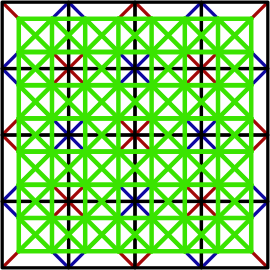
These connections are a subset of the ones possessed by the graph moves a king can make on the regular square grid.. We can represent the missing connections by adding voids at certain corners. Then we can tile the “{1, 2, 3}-kings” on this grid:
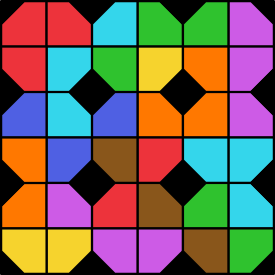
This tiling is equivalent to the previous one. It loses some elegance by not using a noble tiling, but it certainly gains legibility! One advantage to this format is that I could use it directly in Polysolver. The other tilings in this half-tan miniseries, (excepting the one Bryce Herdt found in the previous post) I found manually, with some tedium.

And that’s all I’ve got on poly-half-tans! As an aside, nobility has been in the news recently. Connor Hill recently proved that there are exactly 146 noble polyhedra, plus a few infinite families. His paper is here, and there was also a good Numberphile video on the topic. I don’t know if the noble multiple euclidean planar tilings have been similarly characterized, but they would make an exciting vein for polyform exploration.

Tantalized by Polytans

There are two fundamental methods for deriving a type of polyform. One is to begin with a tessellation, and consider connected subsets of that tessellation as its associated polyforms. The other is to begin with a single tile, and create instances of a polyform type by agglomeration of ever more copies to the starter tile. Regular polygon tiles do not allow us to distinguish between these methods. The triangle, square, and hexagon give us the same polyforms whether you use their planar tilings or accretion, and the other polygons do not tile the plane at all, and so admit only the latter method.

The tan, (a.k.a. isosceles right triangle) by contrast, does admit both methods in a way that gives us distinct sets of polytans for each. There are 3 different isohedral tilings of the plane with tans:

The first two are topologically equivalent to an equilateral triangle tiling, and polytans based on those tilings can be treated as equivalent to polyiamonds with restricted symmetry actions. But the last one, the tetrakis square tiling, does give us its own set of polyforms. George Sicherman has catalogued the tetrakis grid polytans. (Polytans are called polyaboloes there and in some other sources.) Since both tessellation and agglomeration methods give us reasonable polyform sets from the same base cell, pithier terms for each are desired, so I will go with “grid” and “glom” respectively. Due to the freer choices of orientations for tans, the glom n-tan sets grow much more quickly than the grid n-tans. Here are tilings of the 30 glom pentatans and the 8 grid pentatans:

The glom pentatans solution is from the Poly Pages.

A consideration for both grid and glom polytans is whether we choose to include all of the shapes with the same outline, but different internal divisions. If our only use for a set of shapes is to make a tiling, it may feel awkward to have extra copies of some of them. I fall on the side of preferring sets where all subtilings are present, because they may be relevant for problems other than tiling, and even tiling problems with additional challenges based on the subtilings. (I propose we use the terms “subtiled” and “unsubtiled” to distinguish the cases where different internal tile placements do and respectively do not give us distinct polyforms. There are other polyform types where this distinction is useful; consider polydominoes and polydiamonds.)

The pentatans in the above graphic are unsubtiled. In fact, for grid polytans up to size five, subtiling doesn’t give us extra pieces. But as we go up to hexatans, it does. Here’s a tiling of the subtiled grid tri-ditans:

Notice that there are two L tromino shaped pieces with the same first level subtiling into squares, but a different ultimate subtiling into tans, as well as two trapezoid shaped pieces with different first level subtilings, but the same ultimate subtiling. There is some subtlety in subtiling! [Edit: well, as pretty as that is, I missed a tri-ditan. There’s an S-shaped one with two big tans and a square in the middle. Darn.] [Later edit: okay, here’s the best I can do: use the 16 tri-ditans in the above figure to tile an inflated version of the missing one.]

There are 18 subtiled glom di-ditans, which, fortuitously, can tile a square. I set the additional challenge of finding such a tiling where there was symmetry in the orientations of the base tans. Bryce Herdt found this one:

Herdt reported that this appears to be the only one with this property upon a visual scan of all of the tiling solutions, but it’s possible another might have been missed.

I have, perhaps unjustly, ignored polytans before now. My first inclination when presented with a type of polyform is to ask, does this really give us any insights that we couldn’t have gotten from polyominoes or polyiamonds? When I found my first internet polyformist community in the Polyforms Yahoo group, there seemed to be quite a lot of exploration of new polyforms, and a lot less of new questions to ask about polyforms. So I focused on the latter, and mostly stuck with the most basic polyform types in order to keep to that path. But polytans really do give us important insights, and I hope to find and post about more of them in the future.