
1.
Previously, we looked at what we might mean by such things as “The 3+2-ominoes”, and distilled the beginning of a notation system from that. But before we get very far, we might find some instances where our polyform set addition notation is unsatisfactory. Here are the 2+1+1-ominoes, or 2+1+1■ for short:

It strikes me as I look at these that sometimes I might want to be able to refer to a set that works like just the top row of these. “I want a domino, with a couple of monominoes attached directly to it. Show me all of the ways to do that!” For this, we’ll need a new operator, which I’ll write with a colon and call the with operator. We can now call the top row set 2:(2⊙1)■, or “domino with two monominoes” spoken informallly.
2.
A variation we might want for n+n-forms is to exclude compound forms containing repeats of the same part. For example, in Problem #59, we looked at a component coloring problem involving heterogeneous ditrominoes. We can coöpt “choose” notation, \({S \choose k}\) to give us all of the ways to attach k forms from the polyform set S. Thus we could write the heterogenous ditrominoes as \({3■ \choose 2}\).
As it happens, Bryce Herdt recently solved problem #59. I had shown a component 4-coloring where the L3’s could take two different colors and the I3’s could take the other two colors. (L3 and I3 are the standard abbreviations for the L tromino and the straight tromino.) The problem was to make the 4-coloring strict. Herdt not only succeeded in this, but the 4 possible combinations of colors in a ditromino also make a strict 4-coloring. I have identified each of these color combinations with an outer border color in the diagram below in order to highlight this second 4-coloring.
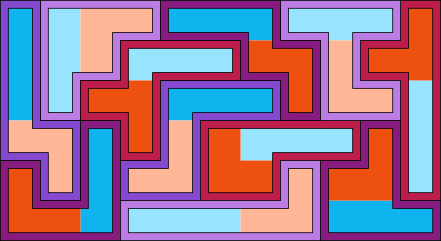
In this case, another way to notate the same set would be L3+I3. Of course, we aren’t defining addition on polyforms themselves, but rather polyform (multi)sets. So let us use the notational convention that italicizing a polyomino abbreviation gives us the set with just that polyomino as a member. (As only polyominoes have standard single letter names, the “■” can be omitted.)
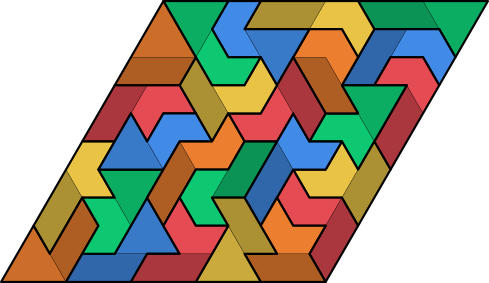
For another example, here are the 25 heterogeneous di-tetriamonds, or \({4▲ \choose 2}\). Since the number of cells is twice a square, they can tile a rhombus of edge length 10.
I still have more entries in this series planned. A comprehensive system of polyform set notation may never be able to describe every set of polyforms we might encounter, but to the extent that it can make exploring and keeping track of polyform sets easier, it does seem like a worthy goal.

