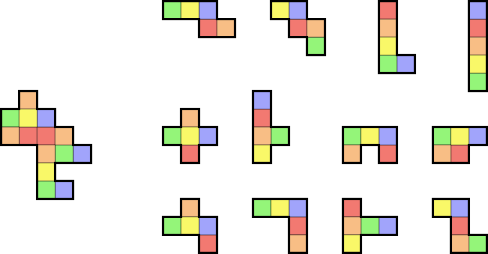
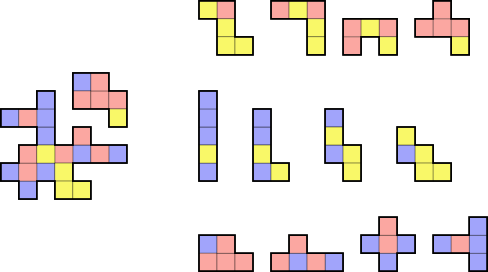
I’m going to be sharing a few different puzzles I’ve discovered that share the theme of path building. The first is a pretty polyiamond puzzle I recently prototyped; the other two have been split into a second post.
Path puzzles are a natural extension of edge matching. Instead of just marking edges in some way so that we can match like markings, we can choose and connect any pair of edges. Then we can make challenges involving the paths spanning multiple tiles that are formed. I’ve examined cell markings on polyforms a fair amount here, but I’ve left edge markings understudied. One reason is that the combinatorial explosion of possibilities can become overwhelming. The L-tetromino (to pick a simple asymmetric example) has 16 different cell markings if each cell can either be marked or not. Kadon sells this set in an 8×8 square frame as L-Sixteen. Since the L-tetromino has 10 edge segments, there are 2^10 = 1024 different markings if we do the same with the edges. If someone made this, it’d need a 64×64 square frame!

It’s probably little surprise then that most puzzles involving edge markings use simple squares or hexagons. But recently, when I was looking for something to do with diamonds and triamonds, I found a nice set for a path puzzle.
But first, an aside on why I was looking at diamonds and triamonds. My recent puzzles with row and column pip sum challenges used multiple copies of small polyominoes with different markings. The ability to exchange copies of the same shape usefully inflates the size of the search spaces for those puzzles. But tile placement remains an important aspect, even if the finding a tiling is easy, so it still has the feel of a polyform puzzle. In a sense, these puzzles “punch above their weight” in terms of the amount of puzzle you get for the size. I wanted to find other puzzles like this, and started to look at polyiamonds. For small polyiamonds, a hexagon of side length 2 seemed like the ideal frame.
There are a number of ways to divide up the 24 cells of that hexagon, but 3 diamonds and 6 triamonds was a top candidate. I tried magic pip sum puzzles first with mixed results, but then I checked the ways to connect edge segments and found that I got exactly 3 diamonds and 6 triamonds. And making paths with them is indeed a nice manual puzzle.

After I came up with this I was curious about which exits from the hexagon it is possible to get to from a given starting point. The darker triangles overlaid on that diagram give a clue: the number of transitions between dark and light squares must always be the same, however the pieces are placed. This means that the path must always enter and leave the hexagon at triangles of the same color, so only the positions marked 1, 4, 5, and 8 are possible exits if you start at the ★. Solutions do exist for each. (Positions marked with the same number give equivalent paths by symmetry.)
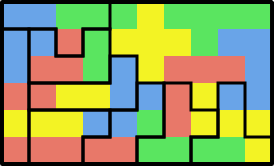
I later produced a lasercut acrylic prototype of the puzzle. Here it is:

One change I’d like to make for a production version would be to cut a circle in the frame around the hexagon so that the whole puzzle can be easily rotated, allowing the ends to match the symbols. As it is, you might find a solution that connects “wrong” edges, and it’s a pain to take the pieces out and put them back in the right orientation.
In future posts, I can promise not only more path puzzles, but also another “compact gem” of small polyform sets with big puzzling possibilities.