Posts Tagged ‘polyominoes’

Maximal Irreducible Contiguous Covers

April 28th, 2011

A cover of a set of polyforms is a shape (or set of shapes) into which each member of the set could fit. Mostly I’ve looked at problems involving minimizing the size of a cover. This problem goes the other direction.

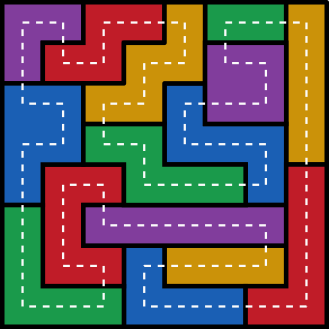
A reducible cover is one where a cell can be removed and the remaining figure is still a cover. An interesting problem then is to find an irreducible cover in a single piece that is as large as possible. (Why a single piece? Well, without specifying that, the largest irreducible cover will simply be all of the shapes in the set in separate pieces.) Here’s a (conjectured) maximal irreducible contiguous cover (MICC) of the pentominoes:

The above solution has been on my polyomino cover page for a while. Here are a couple of new results, (still just conjectured since I found them by hand rather than exhaustive computer search, and I am not able as yet to prove they are maximal.)


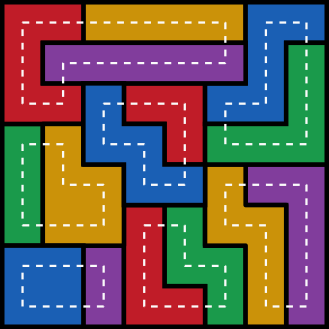
An MICC (?) of the hexiamonds


An MICC (?) of the pentaedges (shown in two copies for clarity)

Between these solutions, we see some patterns emerging. Certain polyforms are in some sense distinctive: they have features that do not occur in other polyforms in the set. This makes it easy to make a large cover that includes exactly one copy of them. Other polyforms end up serving a connective function. For example, there are quite a few occurrences of the L pentomino in the first figure, so removing a cell will never make the cover cease to include an L. By using a few pentominoes as many times as possible in this connective function, more pentominoes are left over to occur singularly.  In some cases multiple polyforms that occur only once are forced to overlap, so we don’t get their full number of cells to add to the cover, but we do get a few. This is shown with the outlined hexiamonds above. In the case of the pentominoes, we have one cell where two T pentominoes overlap; since these are the only two T pentominoes in the figure, the cell can’t be removed from the cover.

Problem #25: Find maximal irriducible contiguous covers of anything and everything! This problem ought to yield interesting results for any kind of polyform you can throw at it.

One final note: It was slightly unfortunate that I chose the word “cover” to represent a concept in polyforms when it already had an unrelated meaning in graph theory; it’s even more problematic now that I’m using graphs themselves as polyforms. It appears that in graph theory, the appropriate term is “common supergraph”. I could use “common superform”, although one problem is that polyforms, unlike graphs, are generally not allowed to be disconnected, and for some problems (though not this one) we want sets of polyforms that aren’t connected to each other. Perhaps “common superformsets” in that case, as ugly as it sounds.

A Semimagic Magic 45-omino

March 1st, 2011

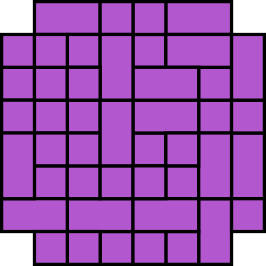
Bryce Herdt has found a solution to problem #21:

The shape of the darker region is “magic” because the number of cells in each 3×3 block corresponds to a number in a magic square, while the number of cells in each row, column, and main diagonal is 5. The sum of the numbers in each row and column is 115.

There’s still room for improvement here: note that the diagonals do not add up to the magic sum. (A mostly magic square with this property is called semimagic.)

Problem #21.1 Find a magic magic 45-omino, as above, but with diagonals adding to the magic sum.

It’s interesting that this solution was found by manually tweaking the output of a program that I wrote to solve the problem. I was never able to get the program to find an actual solution, so I had it give up after a certain number of trials and output the best near solution. There may well be a large number of solutions, but the search space is enormous.

It’s pretty simple to get fairly close by picking a random permutation of numbers and repeatedly swapping them around to get sums closer to the magic sum. But getting from this local minimum to a real solution is the hard part. The problem would seem to call for something like simulated annealing, and indeed I found a reference to a magic square finder algorithm using something similar. (It should be noted that if all you want is a magic square of a given size, there are deterministic methods that will get you one very quickly.) I added a hack to my code to make it do a crude version of this, but it doesn’t seem to have helped much. (The near solution that Herdt fixed up was made with the old version of the code.)

Feel free to look at my solver code (in Python). I do wonder if there is some way it can be fixed up to be better at getting from near solutions to real solutions.

3×3 block Pentominoes and Hexominoes

January 21st, 2011

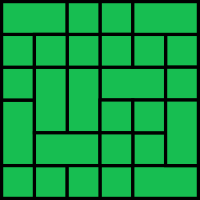
There are 8 pentominoes and 8 hexominoes that fit in a 3×3 cell. The combined set seems to cry out to be presented in a 4×4 grid of 3×3 blocks, with the pentominoes and hexominoes in checkered positions:

The best I could think to do was make a figure that is connected, hole-free, and has a rotationally symmetrical pattern of connections between blocks. I had hoped to make them into a geomagic square, but now I’m pessimistic about that working. And the trick from my magic 45-ominoes of making all rows and columns have the same number of cells in polyominoes won’t work here because the total number in each row of 3×3 blocks is 22, which isn’t divisible by 3.

I’ve looked before at problems involving moving a single cell at a time to cycle through a set of polyforms. Because this set has equal numbers of pieces at two consecutive sizes, it invites using adding and removing single cells, rather than moving them, as the action for taking one piece to the next in a path:

Because the X pentomino has only one possible predecessor or successor, it cannot be part of a cycle, but it is still possible to make a path through all of these pentominoes and hexominoes with the X as one of its endpoints.

Magic Squares and Polyominoes

January 21st, 2011

Lee Sallows recently created a new site, geomagicsquares.com, about geometric magic squares. These differ from standard magic squares in that the numbers are replaced with shapes, and instead of having a magic sum which all of the rows, columns, and main diagonals must add up to, they have a target shape that the shapes in each row, column, and main diagonal must tile. (As in standard magic squares, each entry in the square must differ from all of the others. I really recommend the site highly; the presentation of the geometric magic squares is nearly as beautiful as the underlying mathematics. Many (but not all) of the geometric magic squares there use polyominoes or other polyforms.

Several years ago, I came up with a different way of combining polyominoes and magic squares. My magic 45-ominoes are polyominoes contained in a 3×3 configuration of 3×3 blocks, such that each row, column, and main diagonal has 5 cells within the polyomino, and each 3×3 block has a number of cells corresponding to a number in a magic square.

After reading Sallows’ site, I wanted to try my own hand at a geomagic square, and I came up with a variation that incorporates ideas from my magic 45-ominoes:

The rows and columns in the diagram all contain 5 cells. I wasn’t able to make the main diagonals work out. Maybe you can?

#20: Find a geomagic square of polyominoes that can be presented in a 3×3 grid of 3×3 blocks as above, where all rows, columns, and main diagonals have an equal number of cells that are contained within polyominoes.

By the way, I’m still looking for what I call a Magic Magic 45-omino; that is, a Magic 45-omino where each cell contains a different number between 1 and 45, and each row and column adds up to 115. (Make that problem #21.) Here’s a near solution:

All Pentominoes in 5

December 13th, 2010

I’ve been thinking about variations on the problem of cycling through all twelve pentominoes by moving a single cell at a time. (I wrote about this in a previous post.) Constraining the way that the squares are allowed to move led to something almost like a chess problem.

The problem:

Starting with the above position, take five turns as follows:

A turn consists of moving one white knight, then moving one black knight, according to standard chess rules.

After each turn, the squares occupied by the ten knights must form two separate pentominoes.

After the fifth turn, all twelve pentominoes must have appeared exactly once. (This includes the two that are present in the starting position.)

[I may make a separate post discussing and spoiling the puzzle later.]

Rectangular Pentominoes

October 29th, 2010

When I had Agincourt made, I purchased a bulk order of 4″ × 4″ × 1″ white cardboard jewelry boxes. They look quite nice, and they fit both Agincourt and L-Topia, but I have enough of them that I’m on the lookout for ideas for polyform puzzles that fit nicely into a few square layers. And now I’ve found one:

I stumbled upon this by noticing that there are 21 pentominoes of this symmetry type, which could make three 5 × 7 layers. I wanted square layers; usefully, squashing the cells into rectangles with a 5 : 7 ratio of width to length simultaneously gave me the square layers and gave the cells the right type of symmetry.

It’s been observed that any of the subgroups of the symmetries of the square can be used as the basis for a type of polyomino puzzle. (See Peter Esser on pentomino variations, and particularly the page on parallel polarized pentominoes, which are equivalent to rectangular pentominoes.) For Agincourt, I physically realized one of these types by laser-cutting symmetrical, arrow-shaped holes in every square cell. Other types have been made by changing the shape of the cells themselves. Rhombic pentomino sets have been produced by Kadon as Rhombiominoes. Sets of rectangular polyominoes, shaped like Meiji chocolate bars, have been produced by Hanayama. (These may not be equivalent to the rectangular polyominoes above, if the top is distinct from the bottom, which isn’t clear from the pictures there.) I’m not aware of anyone who is producing complete sets of rectangular pentominoes, so there’s a gap I’m willing to step into.

If you take out the pentominoes with a diagonal line of symmetry in their non-squashed form, (the green ones above) the remaining 18 pentominoes come in 9 pairs, where each pair contains two different squashed versions of the same pentomino. With these pieces it is interesting to try to tile a pair of shapes with the same orientation such that one piece from each piece pair is in each shape. (Note that if the two shapes had different orientations, you could always make the second shape with corresponding pieces in the same position as the first, but squashed in the other direction.)

Since the set has area 90, the obvious thing to try is two 9×5 rectangles. The next most obvious thing to try is two 7×7 squares with corners removed. Neither of these seem to work, although I have no proof.

One thing that does work is a 7×7 square with a 4×4 square cut out of one corner. But this is again just the case where you can trivially get the solution to the second piece by squashing the pieces differently, because this shape has diagonal “mirror symmetry”.

Another problem is finding three congruent shapes, each of which has the following property: three of its pieces have their twin in one of the other two shapes, and three have their twin in the remaining shape:

I’m looking into having some sets of the rectangular polyominoes made, and if I can do so economically, I’ll sell them through the store. (Sadly, TechShop Portland, the facility where I made Agincourt, has gone away, so I will need to look at other options.)

Polystick Problems from Polyomino Solutions

September 7th, 2010

Polysticks (or polylines) are connected sets of segments in a square grid. (Polysticks on other grids are possible, but haven’t seen much attention.) The tetrasticks, of which there are 16, seem to be the most natural set for puzzle making. Donald Knuth has explored tetrastick problems, and posed the problem of tiling an Aztec Diamond with the 25 one-sided tetrasticks, which was solved by Alfred Wasserman. Here’s one I’ve come up with:

Problem #15: Tile the above shape with two sets of the five tetrominos and one monomino, and tile the borders of these polyominoes with the 16 tetrasticks. Here’s an attempt I made that fell short by a few tetrasticks, but it should give you an idea of the form a solution would take:

The observation that the lines formed by the pieces in a polyomino tiling could themselves be tiled by polysticks seems obvious, but I have not seen it elsewhere. After picking the 16 tetrasticks as my puzzle pieces for the polystick stage, I had to find a set of polyominoes to use. Since one of the tetrasticks is, in fact, the outline of a 1×1 square, or monomino, the monomino had to be present. A double set of tetrominoes plus the monomino gives a good quantity of segments for our tetrasticks to cover, and gives us an area of 2 * (5*4) + 1 = 41. The perimeter of the figure to be tiled is constrained by the following formula:

2 * total segments in the polystick set – sum of perimeters of polyominoes = perimeter of entire figure

In this case, (2 * (4 * 16)) – (4 + 2 * 48) = 28

So I needed a figure to tile with area 41 and perimeter 28, and came up with the shape above.

There are 136 solutions for the tetromino tiling with the monomino in the center as shown. (See these solutions in a Java solver applet.) I’ve experimented a little with the tetrastick stage of the problem by hand, and I’m convinced that there are no tetrastick solutions for most, if not all, of these tetromino solutions. But if it doesn’t work out in the case with the monomino in the center, I suspect there are enough solutions with the monomino elsewhere for it to be very likely that one will work. Many of the tetromino solutions fail to contain a site where the “+” tetrastick can be placed that doesn’t overlap the “□”.

Another issue that surfaces in this problem is horizontal-vertical segment parity. Eleven of the tetrasticks have even parity, that is, however you place them, they will always contain even numbers of both horizontal and vertical segments. Five of them have odd parity, and will always contain three segments of one orientation and one of the other. Because there are an odd number of pieces of odd parity, the parity of the set of tetrasticks as a whole must be odd. This means, without even starting to try placing tetrasticks on a tetromino solution, we can rule out the possibility of tiling it just by counting the number of horizontal or vertical segments. (Because the total is constant, we don’t need to count both.) If that number is even, the tetrasticks can’t tile the figure. The tetromino solution that I used in my attempt above has the correct (odd) parity.

I dredged this problem up from my archive of the polyforms mailing list, where I posted it in February, 2001. It got no takers then, but I thought it an interesting enough problem to deserve a second airing. I looked for other problems of this type in preparing this post, but I didn’t find anything good. Having both the area and the perimeter of the figure to be tiled constrained by the pieces used limits the possibilities a lot.

Gordon Hamilton’s Polyanimal Zoo

April 6th, 2010

Here’s a problem that I heard from Gordon Hamilton at Gathering for Gardner 9, and tracked down to an article of his in issue #10 of Pi in the Sky, a western Canadian math magazine for high school students and teachers.

A polyomino animal can eat another polyomino animal (his perhaps overly cute term is “polyanimal”) if the second one can be placed inside the first. Find animals of sizes 4, 5, 6, 7, 8, 9, and 10 that can live together peacefully (none can eat any of the others) within a 7×7 square pen.

This is really a satisfying puzzle to solve. Usually in polyform tiling puzzles, you spend a fair amount of time feeling out the territory, learning which pieces like to go in certain places, and which you want to deal with first and which you want to save for the end. But then, the larger part of the solving time is spent in trial and error with various configurations attempted at random until at last you run into a solution.

Here, the whole solving process is learning about the territory of the puzzle, and none of it feels like random crunching. I highly recommend giving it a try, but if you just want to see a solution, mine is here.

Of course, the matter of polyominoes fitting inside other polyominoes is an area that I’ve dealt with in my Polyomino Cover material, which I summarized in my presentation for G4G9. And one of the problems in Hamilton’s Polyanimal problem set is the same as what I’ve called the minimal pentomino cover problem. But most of them are completely different, which only reinforces my belief that this is an area with a lot more waiting to be discovered. (His last problem is “Design a Polyanimal Game.” Now that’s open-ended and provocative!)

Pentomino Cover Cycles

March 17th, 2010

What’s the smallest shape into which any of the 12 pentominoes can be placed? I call this old chestnut the “minimal pentomino cover” problem, and I’ve spent a lot of time working on a number of variations on it. For the purpose of introducing and illustrating the basic problem to my dear readers, I wanted to use an animated GIF file showing all of the pentominoes in turn being placed on a minimal cover.

An aesthetically pleasing way to cycle through the pentominoes would be to move one square at a time. This is in fact possible:

A couple of variations on the problem of finding such a cycle suggest themselves:

#9: Minimize the total distance the squares move per cycle. The taxicab metric seems to be more sensible and simpler than Euclidean distances here. I made no attempt to do any minimization in the above solution, so I’m sure there is room for improvement.

#10: If you gave every square in the pentominoes a distinct color, and kept the color the same when a square moved, you could keep track of where the squares end up at the end of a cycle. During the cycle illustrated above, two pairs of squares switch places. Is there a cycle of single-square moves through the pentominoes that ends with each square in the same place it began?

Notice that the central square can never move, because the only pentomino placement without the central square is one of the P pentomino, for which the only valid square movements turn it into a U pentomino. It would need movements to two different pentominoes to be part of a cycle.

For both of the above problems, the other 9 square pentomino cover would also be a valid substrate:

Since this one has no immobile squares, another problem using it may be solvable:

#11: Find a cycle where the permutation of the squares from one cycle to the next is cyclic (in the second sense in the linked article.) That is, successive iterations of the cycle will eventually take each square in a pentomino to all of the other positions in that pentomino.


Some very good news: I’ve been invited to the 9th Gathering for Gardner conference in Atlanta later this month. The Gathering for Gardner is an invitation-only conference  held in honor of Martin Gardner, who brought recreational mathematics to a generation through his columns in Scientific American. That generation was not my generation, but it was impossible to miss his imprint on later writers, and I’ve picked up used copies of several of the collections of his columns. A large proportion of the names on the spines on my recreational mathematics bookshelf are represented among the invitees, so this will be really special for me.

Pentomino Layer Cake

February 27th, 2010

On the Polyforms list, Erich Friedman posed a very interesting new pentomino tiling problem:

Tile a rectangle of minimal area with pentominoes so that for each pentomino there is exactly one stratum, or cluster of one or more copies of that pentomino that reaches from one side of the rectangle to the opposite side. Pentominoes in a stratum must form a single group, connected by edges, not just corners.

Michael Reid found this 3×30 solution:

It’s not hard to prove that it is minimal. A natural extension of the problem is to find minimal solutions for 4×n and 5×n rectangles. Michael Reid found the first 5×n solution, but I improved on it with this 5×32 solution:

The 4×n problem seems to be the hardest, and initially it was not clear that it would be possible. The X pentomino has only one possible stratum, which only can only be bordered by Y, I or N, and it is also difficult to find matches for a Z stratum. Additionally, only Y, L, and P can form straight line stratum boundaries usable for the top and bottom of the rectangle. (See wikipedia’s pentomino page if you don’t know the correspondence between letters and shapes.) I did eventually find this 4×50 solution:

This solution seems rather prolifigate with its pentominoes, but finding any solution at all was a bit of a surprise.

Update: Erich Friedman’s Math Magic for April 2010 further explored this subject.

Introducing Agincourt (to the Blog)

February 25th, 2010

Agincourt is one of the lasercut acrylic puzzles which I’m selling through the store. It’s the set of all of the ways to make 2-, 3-, and 4-ominoes with arrow shaped holes in each square pointing in the same direction. The symmetry of the arrows means that you can flip over pieces without changing the arrow directions, but you can’t rotate them. Most of the puzzles I have designed for the set ask for the solver to make all pieces point the same way, but the arrows naturally suggest a scoring system to handicap the puzzle for different levels of solvers — just count the number of pieces you had to put in the wrong direction, and try to improve on your score.

Here’s a solution to the puzzle that literally comes out of the box. (The puzzle comes in the box with 4 layers of pieces in 4 × 4 squares.)

Expect more Agincourt puzzles later.

2-coloring Pentomino Packings

January 24th, 2010

I like to collect pentomino coloring problems.

So it should come as little surprise that I was intrigued by the cover of Puzzle Fun 16. Puzzle Fun was a ‘zine produced by Rodolfo Marcelo Kurchan in the ’90s covering a variety of polyomino problems. I missed out on subscribing to it myself, and the Puzzle Fun website languished for a decade after new issues stopped appearing.

A few months ago, Kurchan put the content of all of the back issues of Puzzle Fun online.

Puzzle Fun 16 focused on pentomino packing problems. Packing problems differ from tiling problems in that empty space is allowed, and the goal is to minimize the amount of empty space required. Packing, usefully, makes some kinds of problems possible to solve that would not be solvable as tiling problems.

One such puzzle type is packing polyforms that are 2-colorable, (that is, one can use two colors to color every piece such that no piece touches another of the same color.) This is the puzzle type I saw on the cover of Puzzle Fun 16.

The problem itself was this: Place two sets of pentominoes in the smallest possible rectangle such that no pentomino touches another in the same set. [PF problem #549]

A solution was printed in Puzzle Fun 18:

(Solution by Hector San Segundo.)

I should note that this problem implies strict coloring: pieces are not allowed to touch even at corners. I am more interested in non-strict coloring, which is generally the default in coloring problems, and I am interested in colorings of a single set of pentominoes. (Which all of the problems on my pentomino coloring page are.)

#1: Place a 2-colorable (non-strict coloring) set of pentominoes in the smallest possible rectangle. My best attempt has 65 squares:

Filling out the matrix of variations gives two more problems:

#2: As #1, but with a strict coloring.

#3: As in PF #549, but with a non-strict coloring.

(The following problem in PF 16 (#550) was a variation on #549 minimizing perimeter rather than area, but this is less interesting to me.)

http://www.puzzlefun.com.ar/