
There are nine proper 4-WFD-ominoes:

Recall that a proper WFD-omino is one where every spanning tree of W, F or D connections between the cells includes at least one of each. Recall that W, F, and D connections correspond to the moves of the Wazir, Ferz, and Dabbaba in historical chess variants. And recall that these moves are, respectively, a one space orthogonal move, a one space diagonal move, and a two space orthogonal jump respectively. (It’s fine if you don’t recall these things. I’ll recall them for you. Or you can read this post, and then recall them.) The full set is the right size to tile a 6×6 square. And indeed, it can!
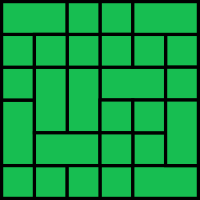
And yet, you might find that graphic just a little unsatisfying. The solver that I use for polyomino tilings displays results with all of the pieces in the same color. This is fine for standard polyominoes, but for disconnected (or differently connected) polyominoes, it’s hard to see where all of the loose monominoes fit. But that just turns reconstructing the tiling into a logic puzzle. Indeed, there are entry points where a domino is constrained to be in a particular proper 4-WFD-omino, which removes certain monominoes from consideration and forces other dominoes to belong with their monominoes, and like a sudoku, the chain of logic eventually forces a complete solution. Try it!
But a 6×6 puzzle may feel a little small if you’re used to Sudoku or other puzzles in the Nikoli mold. So let’s try out the proper 4-WFA-ominoes. (Recall that the A (Alfil) is a two space diagonal jump.) There are 15 of these:

They have area 60, so they can tile a 8×8 square with corners removed, just like the 12 pentominoes.
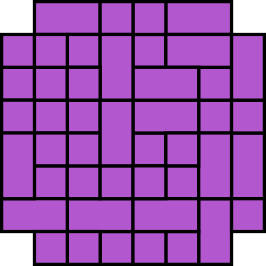
Reconstructing the tiling here is a substantially harder puzzle than the previous one. The monominoes belonging with particular dominoes can be farther flung, which makes it harder to constrain which bits must be connected. I had to try out a large number of tilings before I found one where I could make some headway in the reconstruction puzzle. But rest assured that I did indeed solve this one.
Where to go from here? There are 21 proper 4-WFN-ominoes, (recall that N is for knight) but they have odd checkerboard parity, which interferes with trying to find a nice thing for them to tile. Another possibility would be to combine the proper 4-WFDs and 4-WFAs in a single puzzle. Either way would make it even more difficult to constrain which monominoes go with the dominoes. There may be solvable reconstruction puzzles in the space of tilings, but the strategy of picking tilings at random to find solvable ones will probably break down. I suspect that there are more good puzzles in this vein waiting to be discovered, but they may require more creativity in coming up with new piece sets that will work, or in puzzle design or discovery techniques.


