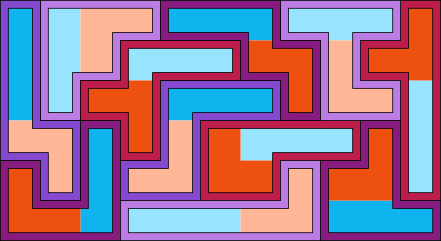
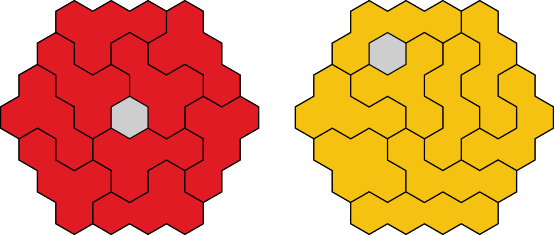
Marking external edges of polyforms leads naturally to restrictions on tilings that make for good puzzles. We can simply match marked edges, and if two edges on each piece are marked, we can draw a path between them and make challenges based on properties of the paths formed. Internal cell edges on pieces can also be marked. Since there isn’t a “natural” challenge using these markings, we’ll have to be creative. Here’s a tiling of all 12 ways to mark a single internal edge in a 5-iamond, where the markings have reflection symmetry:
Ah, symmetry, the first resort of the lazy polyform problemist. More symmetry is always better, so that’s Problem #65: Find a tiling of the above figure with the same pieces, where the edge markings have 3-fold rotation symmetry.
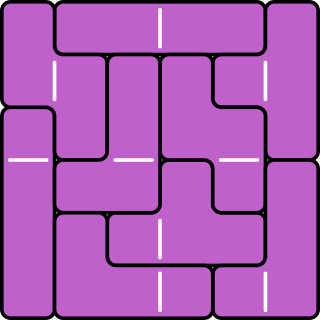
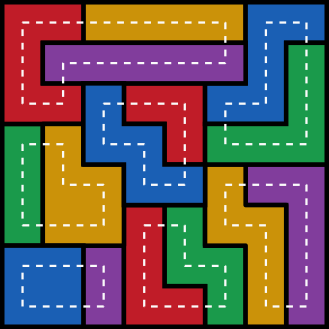
There are 10 ways to mark an internal edge in a 4-omino. The challenge that I’ve devised is to place the pieces so that no edge mark is on the same line as an empty internal edge. One of the pieces, the marked square tetromino, inherently breaks this constraint. So, by the law of exclusion of inconvenient pieces, it has to go.
Excluding the inconvenient piece lets us tile a square, giving us a little extra symmetry compared to the rectangle we would have otherwise been forced to tile.
If inconvenient piece exclusion is the first step toward becoming a dirty puzzle designer instead of a pure and noble recreational mathematician, surely the extra symmetry will stand as penitence for my sin.
Previously, we looked at what we might mean by such things as “The 3+2-ominoes”, and distilled the beginning of a notation system from that. But before we get very far, we might find some instances where our polyform set addition notation is unsatisfactory. Here are the 2+1+1-ominoes, or 2+1+1■ for short:
It strikes me as I look at these that sometimes I might want to be able to refer to a set that works like just the top row of these. “I want a domino, with a couple of monominoes attached directly to it. Show me all of the ways to do that!” For this, we’ll need a new operator, which I’ll write with a colon and call the with operator. We can now call the top row set 2:(2⊙1)■, or “domino with two monominoes” spoken informallly.
2.
A variation we might want for n+n-forms is to exclude compound forms containing repeats of the same part. For example, in Problem #59, we looked at a component coloring problem involving heterogeneous ditrominoes. We can coöpt “choose” notation, \({S \choose k}\) to give us all of the ways to attach k forms from the polyform set S. Thus we could write the heterogenous ditrominoes as \({3■ \choose 2}\).
As it happens, Bryce Herdt recently solved problem #59. I had shown a component 4-coloring where the L3’s could take two different colors and the I3’s could take the other two colors. (L3 and I3 are the standard abbreviations for the L tromino and the straight tromino.) The problem was to make the 4-coloring strict. Herdt not only succeeded in this, but the 4 possible combinations of colors in a ditromino also make a strict 4-coloring. I have identified each of these color combinations with an outer border color in the diagram below in order to highlight this second 4-coloring.
In this case, another way to notate the same set would be L3+I3. Of course, we aren’t defining addition on polyforms themselves, but rather polyform (multi)sets. So let us use the notational convention that italicizing a polyomino abbreviation gives us the set with just that polyomino as a member. (As only polyominoes have standard single letter names, the “■” can be omitted.)
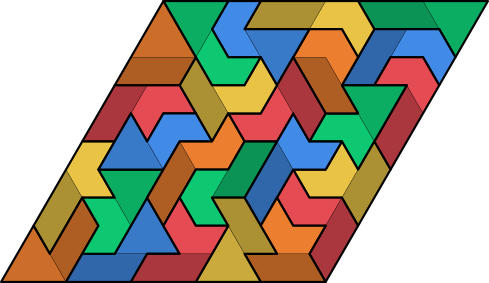
For another example, here are the 25 heterogeneous di-tetriamonds, or \({4▲ \choose 2}\). Since the number of cells is twice a square, they can tile a rhombus of edge length 10.
I still have more entries in this series planned. A comprehensive system of polyform set notation may never be able to describe every set of polyforms we might encounter, but to the extent that it can make exploring and keeping track of polyform sets easier, it does seem like a worthy goal.
In planning out blog posts, I typically use the rule of thumb that a post should contain between two and four images. If I have five or more images, I try to break the material up into multiple posts, and if I have only one I will usually wait until I have more material. A single image is a still life; when there are more, I can tell a small story. Unfortunately, this means that over time I build up a number of “orphans”, perfectly good results left to gather dust because I have nothing else that is closely related. I recently noticed that several of my orphans were square shaped. Perhaps I could use this to tie some disparate results that normally wouldn’t belong together into the same post.
1) I noticed last year that the tetrakis grid 4- and 5-tans had a combined area that could make a square. This seemed like a pretty basic result that had to have been known years before. I asked (and looked) around, but I couldn’t find any instances of it being found previously. Then in preparing this post, I discovered that I was almost right. It had, in fact, been foundmonths before, by Thimo Rosenkranz. (That page isn’t visibly dated, but a timestamp in the html code indicates it was published in July of 2023.) For all I know, these pieces may have been studied many times previously, but having done the important step of preventing myself from falsely claiming primacy, I am content to leave off further historical research.
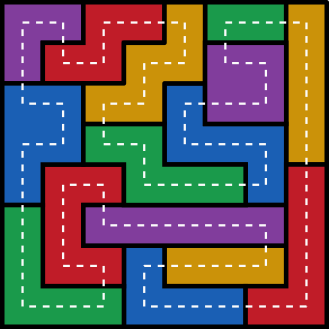
2) I claimed that I couldn’t do anything elegant with just the set of single-striped tetrominoes, but shortly after I posted that, I found the figure below. Here, I relaxed the rule that the stripes must form an unbroken line from one edge of a figure to another. Instead the stripes may have a singe-cell gap in order to allow a perpendicular stripe to pass through. A woven pattern, where each stripe crosses one other and allows another to cross it, seemed like the nicest possibility. (The faded dashed lines are artistic license on my part, not actual markings on the pieces.)
3) The pieces here are based on those in my L-Topia puzzle. That puzzle contained every way to mark two cells of an L tetromino with a circular and a square hole. When I had access to a laser cutter in 2009, I made a variation where, instead, the holes were double headed arrows that could point horizontally or vertically. I was recently reconsidering “pilings”, (tilings with overlap) and wondered what could be done with pieces with marking sites where the markings have two possible orientations by symmetry, and the overlaps must match one orientation with the other. My L-Topia variation came to mind, but I had better results with a similar variation, where the arrows would be diagonal instead. Here, instead of cutting out arrow-shaped holes, I cut out triangles on opposite corners, leaving a bar to overlap. There is a unique piling where the overlaps form a single loop joining all of the pieces.
4) At G4G15, I gave a talk on polykings and other polyomino variations where cells are connected in different ways from standard polyominoes. I based the talk on a couple of earlier blog posts, but I did throw in one additional result. One of my usual creative tricks is “mix ideas, even if they aren’t meant to be mixed.” In the context of tiling problems, that can work out to “tile with sets of pieces that aren’t meant to be mixed.” If we build the five tetrominoes with each of the five shortest cell connection types, we get 100 total cells. Why not throw them together into a 10×10 square? In the diagram below, each tetromino form is represented by a different color, while the crosses indicate the directions and magnitudes of the connection vectors.
Problem #64: Well, everything is always nicer if you can make things of the same kind not touch. Here that means both tetrominoes of the same form, and tetrominoes with the same connection type. But asking for both may be too much, so we may have to accept just one or the other. But wait! What exactly do we mean by not touching here? Simply using Wazirwise adjacency seems contrary to the spirit of the thing. Let us say that two pieces touch if the connection type of one of the pieces can reach, from one of its cells, a cell in the other piece.
We might like there to be some theme that we can tease out from these unrelated square tilings that can retroactively justify shoveling them into the same post. If there is, it might be parity of elegance. A square has high elegance, having maximal symmetry in a smooth, convex shell. But as a consequence of this elegance, we don’t have many sizes of squares available, just one for each integer, so we have to contrive somewhat inelegant sets of pieces to tile them. In the case of the striped tetrominoes, the fixed dimensions of the square forced me to fudge the stripe placement rules to get the stripes to fit.
Of course, there is no such thing as parity of elegance in the universe of possible tilings; many very inelegant tilings may be found. What we see is the effect of me selecting the most elegant tilings that I can find to share on my blog. In these cases, the elegance of the square justified less elegance in other aspects of the tilings.
A few months ago, I noticed that a king can tour a pentomino tiling so that every cell in each pentomino is visited exactly once in an uninterrupted sequence, and the tour forms a closed loop.
Not every pentomino tiling admits such a tour, but it’s not hard to find one that does. A more restricted form of loop could be made using a wazir (an archaic chess piece that moves one cell orthogonally, W for short) instead of a king. Such loops would be more challenging to find. They also restrict the polyominoes that can occur, for example, only 8 of the pentominoes are available.
There are 18 hexominoes that can be traversed by a wazir without visiting the same cell twice. They can make a W-tourable tiling of a 9×12 rectangle:
When I posted this to the Puzzle Fun Facebook group, Rodolfo Kurchan referred me to a previous exploration of similar pieces in the Journal of Recreational Mathematics. It covered the W-traversable 2- through 5-ominoes, (called “rookominoes” in that source) which have an area of 64, and can tile an 8×8 square. But the passage that Kurchan shared only mentioned tiling the pieces, and didn’t consider tours at all! Could they really have been that close to discovering tours on tilings, and just missed them? I adapted my PolySolver model that I used for the above hexomino tiling to find tilings of these pieces instead. Polysolver could find solutions for this set about 10,000 times faster than for the hexominoes. That made me feel that these toured tilings ought to be well within range of manual solving. Surely the JRM contributors could have found them.
I was intrigued, and wanted to find out if there was more about these rookominoes in the JRM than just that brief passage. I looked up the JRM on WorldCat, and found that there was a copy at Reed College, only about 10 miles away from me.
So I drove over, and found where the JRM bound volumes were kept in the basement of the Reed College library. The material I wanted wasn’t in an article per se, but in a section titled “Solutions to Problems and Conjectures”. I found the piece that Kurchan shared from 1990, but also several more from later issues over the next several years. It turned out that the JRM contributors did indeed consider W-tours on these pieces, and Brian Barwell found the first solution. Another variation considered was maximizing the number of loops. Barwell and Michael Reid found a seven loop solution:
They note that the I pentomino cannot be part of a loop of fewer than three pieces. All of the 12 remaining polyominoes, excepting the square tetromino, cannot make a loop alone. So for all of the pieces to be used, there must be at most six more loops, so seven is the maximum.
These problems are related to the snake polystick Hamiltonian circuit problem I posted some time ago. The paths that the tours take within polyominoes are in fact snake polysticks. One difference is that there are extra monosticks connecting these snakes where the path crosses from one polyomino to the next. Another is that we are taking a complete set of polyominoes rather than a complete set of polysticks. For example, we only use one of the two tetrasticks that can traverse a P pentomino. We could instead use an extra P pentomino, and require that both snake tetrasticks occur.
I’ve left this exercise in library spelunking excited about the possibilities for tours on polyform tilings, but a little saddened about the state of polyform knowledge in the world generally. When I did a web search on “rookominoes”, the only results were indices to Stanford’s archive of Martin Gardner’s papers. (There’s something in Box 54, folder 18. It is highly unlikely that I will ever see the contents of that box.) The Journal of Recreational Mathematics wasn’t too hard to track down, given Kurchan’s tip, but who would even know where to look? With the original publisher defunct, I couldn’t find even an index of article titles not behind a paywall, not that that would help me find material strewn between different “Solutions to Problems and Conjectures” columns over several years. Cubism For Fun has an online index, and back issues are purportedly available, but ordering very many of them would be prohibitive. As for the Polyforms Yahoo group, there I’m up on the rest of the world; I have everything since I joined on my hard drive. Good luck to the next poor soul looking for anything to be found there though. The Puzzle Fun Facebook group should stay around for as long as it takes for Meta to go the way of Yahoo. And everything here? Once I’m no longer around to pay for hosting, it goes into the limbo of stuff you can only find via the Wayback Machine, and only if you already know where to look.
I posted last year about a path puzzle using polyiamond tiles. Those tiles were marked with a complete set of paths between cell edges on the perimeters of diamonds and triamonds. Recently I’ve been exploring a variation on tiles with marked paths. In these tile sets, the paths are constrained to straight lines aligned with the grid and connecting the midpoints of opposite cell edges. By this scheme, there are 16 ways to stripe the tetrominoes. I wasn’t able to come up with any elegant tiling using just these pieces, but with a set of unstriped trominoes, they can make a rectangle with four stripes. We follow the typical rule of path puzzles: the stripes must connect between pieces.
There are nine distinct ways to stripe the three trihexes. There is an arrangement of parallel stripes on the figure below that looks like it could have a solution, but it proved to have none when I checked it with a solver. Luckily, non-parallel stripe lines are perfectly acceptable — as long as their intersections occur outside the tiling!
Striping polyiamonds brings a new complication: the line connecting cell edge midpoints is not perpendicular to the cell edge. That means we can change the direction of paths at piece boundaries. The solution below takes advantage of this feature:
Fortuitously, the striped 2-, 3-, and 4-iamonds together contain 49 triangular cells, allowing us to tile a triangle of side length 7. The striped 4-iamonds alone contain 36 cells, but they are not able to tile the triangle of side length 6.
Where else can we go with stripe problems? Todor Tchervenkov, Roel Huisman, and Edo Timmermans looked at tetrominoes with diagonal stripes on the Puzzle Fun Facebook group. (There are 17, which makes them awkward for tiling with the full set, but there are workarounds.) We could try other stripe orientations on polyiamonds and polyhexes as well. Polytans (or polyominoes with tans added or subtracted) could have line bends at diagonal boundaries similar to what happened with the polyiamonds. Another variation I’m looking at is what can be done with multiple stripes per piece. Stay tuned for more stripe content! (Does that count as a stripe tease?)
Early last year I became aware of a paper by Jamie Tucker-Foltz on Locked Polyomino Tilings. It defines a recombination move on a tiling of n-ominoes as creating a new tiling by removing an adjacent pair of tiles and replacing them with a pair of tiles in different positions. Locked tilings are those that admit no recombination moves. Remarkably, for both 4- and 5-ominoes, there is a unique smallest square locked tiling:
The concept of moves between tilings seemed like a promising source of puzzles. Given a tiling, we could try to find a recombination path to a different tiling with specified properties. For example, starting with a tiling of 12 P pentominoes in a 6×10 rectangle, our goal might be to make recombination moves until we arrive at a tiling with all 12 pentominoes.
But from the perspective of designing a physical puzzle, removing and replacing pieces two at a time seems unnecessarily complicated. A better puzzling experience ought to result from removing and replacing pieces one at a time. This doesn’t create a move between tilings, but works just fine as a move between packings. (In fact, sliding block puzzles can be seen as using just such a move.)
After some experimentation with various sets of polyforms, I came up with one that was very promising. There are 10 one-sided tetrahexes. We can pack 9 copies of one of them in a hexagonal figure, leaving a one-hex hole. Now our goal is to form a packing of the other nine pieces in the same frame. These pieces begin in our unused supply, and at every move, we return one piece from the tiling to the supply, and then take one piece from the supply and put it in the frame. The removed and replaced piece can be the same; there are some positions where we might want to change the orientation of a piece, moving the hole. Notice that we can never have more than one of the pieces in yellow below. This was not a restriction in the original problem from the Tucker-Foltz paper, but it seems like a reasonable one for a physical puzzle where we want to limit the production cost of the pieces.
Here are a couple of representative packings of each set. Can a chain of moves be made from a packing of the first type to one of the second? (Not necessarily the packings shown.) This is Problem #63. I got very close while trying to solve it manually, but I couldn’t get all the way there.
Finally, there was another direction I went in exploring this type of problem which was very fruitful indeed. At one point, before I tried the tetrahexes, I was having difficulty finding any polyform that might work. I decided to try the simplest set of polyforms I could come up with: one-dimensional polyominoes. Of course, 1D polyominoes can be represented as integers, and a tiling is simply an ordered list of integers.
Then I needed moves that could be made on this such a list, and a goal to be achieved by a chain of moves. The simplest moves I could think of were splitting a number into two smaller positive integers that sum to it, and merging two adjacent numbers to produce their sum. Since these moves are inverses of each other, we can backtrack through the space of lists if we need to, which is a nice feature in a puzzle. For a goal, I decided to use reversing the list, at least until I could think of something better.
Now, it’s clear that there are a couple of trivial strategies that prevent this from being any kind of puzzle at all. One is to decompose all of our integers into 1’s, and then recombine them to make our desired list. A simple rule to prevent that is to disallow making a list that contains more than one of the same integer. Another is to combine all of the list into one big number, and then split it down from there. The simple rule I found to prevent that strategy was to disallow any number greater than the greatest number in the original list. As an example, with the list [7, 2], the following chain would be a valid solution: [7, 2] → [6, 1, 2] → [6, 3] → [2, 4, 3] → [2, 7].
After playing with a few lists using these rules, I was surprised to discover that some of them made decidedly non-trivial puzzles. (And I stuck with reversing the list as a goal, as I never did come up with something better.) I wrote up the puzzle as a post on my Mastodon account. And then some funny things happened.
My Mastodon post was picked up by Hacker News, a popular bulletin board site for programmers, where it briefly was ranked high enough to make the front page. Some commenters wrote code to explore different lists, looking for ones with long minimal length solution paths. Others wrote interactive playable versions. Arthur O’Dwyer wrote a blog post about the puzzle. (Read that one for a deeper look at the puzzle and the behavior of different lists. I’m not writing that post here, because it already exists.) Tomas Rokicki submitted an integer sequence related to the behavior of the puzzle to the OEIS. I gave an informal talk about the puzzle at a Gathering 4 Gardner Zoom Social, and I started writing my own snazzy interactive version of the game. With Skona Brittain, who used the puzzle as an activity for young math learners, I presented the puzzle to a group of folks who study mathematical puzzles and pedagogy. This little puzzle that I dashed off a quick Mastodon post about has gotten as much engagement as all of my other explorations in recreational math put together.
And now I must segue to a real world concern. I am very underemployed, and I am looking for work. Part of my motivation for writing that snazzy interactive version was to have a portfolio piece to show off my skills in Javascript, React, and CSS. I am generally looking for web development positions, but I’m also interested in other software development positions. I live in the Portland, Oregon area, but I’m willing to consider remote positions.
This use of a plus sign seems natural enough, but we might want to think a bit more about what it implies. We have established an operation on polyform sets, and a notation for that operation. This raises some questions: what other operations might we want to use? How should we notate them? And finally, can we design a notation system that readably describes a wide variety of polyform sets? (And should we?)
After addition, a notation for multiplication would be handy. We’ve recently looked at di-triamonds and tri-diamonds. We can call these 2·3-iamonds and 3·2-iamonds respectively. Notice that this multiplication, unlike the addition, doesn’t commute. But it does decompose into addition in the natural way; the 3·2-iamonds are the same as the 2+2+2-iamonds.
In a way, we were already using polyform multiplication to define n-forms in the first place. The pentominoes are essentially the 5·monominoes. In the interest of brevity, we can use symbols for common base monoforms:▲, ■, ⬣, and ◣ for the moniamond, monomino, monohex and monotan respectively. If we are consistent with the above examples, a n■ has subdivisions for the individual cells. That may seem a little weird, but it can be useful; a 2×1 rectangle could be either a domino or a tetratan, and we’d like to be able to know which. I won’t show these subdivisions in my graphics unless it aids with clarity.
We would also like to combine sets together into a larger one. This is multiset addition rather than set union, because we could want to work with multiple copies of the same polyform. I’ll use circled operator symbols for multiset operations, even though that’s a little nonstandard. They’re nicely readable, and the circle will be our mnemonic that we’re doing multiset things. The tetrominoes and pentominoes together would be 4⊕5■. We can read the ‘⊕’ as “and”, so 4⊕5■ is read as “the four and five -ominoes”. Making a set from multiple copies of the same set is the same as scalar multiset multiplication. So five copies of the tetrominoes is 5⊙4■. As before, this is non-commutative left multiplication; the dot is our mnemonic for that. And it decomposes as expected into multiset addition: 5⊙4■ = 4⊕4⊕4⊕4⊕4■. I can’t think of any reason I would ever want to do element-wise multiset multiplication with polyforms, but ⊗ is there if I ever need it.
Now that we have multiset operations and polyform connection operations, we can start to combine them. There are 22 4+1■. I hope to share more problems involving them soon, but one thing I noticed was that with some smaller pieces included I could get an area of 144, and make a square. With my notation system, I can call these 2+1⊕3+1⊕4+1■. Or I could write that as (2⊕3⊕4)+1■. Polyform addition distributes over multiset operations!
(Well, I could have made a square. I’m showing this shape instead because PolySolver wasn’t finding solutions for the square with separated monominoes. Thanks to Bryce Herdt for showing me a technique for getting PolySolver to find solutions with this property.)
Finally, I must address the final question from the start of this post. Is a notation system for polyform sets actually a reasonable thing to develop, given that I am a lone crank and nobody else is likely to use this stuff? And I think that I am finding, for my own explorations with polyforms, that the answer is yes. With algebraic notation, the concepts behind the notation can be expressed with words, and were for a long time. But symbols are easier to mentally manipulate, and formulas that could not fit into working memory as a paragraph can do so as a modest number of symbols. I am already finding it easier to think about polyform sets because I have symbolic notation for them. As I hinted in my fuzzy polyominoes post, I’m working on notation for related concepts, so more posts on polyform notation are sure to follow.
In 2022, Jacques Ferroul sent some notes on a remarkable exploration in polyominoes to Kate Jones, who shared them with George Sicherman, who in turn forwarded them to me. I quickly saw that there was quite a lot of potential there, and exchanged a few emails with Ferroul, where we shared ideas riffing off of his original notes. And then I let the matter go, since it would seem unkind to scoop his discoveries in a blog post when he still hadn’t written about them for public consumption. Recently, I came back to thinking about them in the context of a notation system for polyform tile sets that I had been noodling upon. And when I looked to see what he had been up to lately, I found a note on Kadon’s page for a puzzle he designed, stating that he died in December 2023.
Well, crap.
So I guess I can write this post now. A fuzzy pentomino, in Ferroul’s conception, is an equivalence class of tetrominoes connected to weighted adjacent cells where the weights sum to one. All of the figures below are the same fuzzy pentomino:
Equivalence classes of polyominoes shouldn’t be wholly unfamiliar. We use them for aspects of the same polyomino with different symmetries applied. Ferroul was inspired by fuzzy logic, where truth values can take on any value between 0 and 1. (I can also see an analogy to the “cloud of probabilities” model of electrons in an atom.) A simpler version, where the added cell is constrained to have a weight of 1, Ferroul calls “boolean polyominoes”.
When we use fuzzy polyominoes in a tiling, we allow cells from different polyominoes to overlap as long as their weights sum to one. Now it’s reasonable to ask: does this lead to interesting tiling problems? And I think the answer is, not directly! Restricting ourselves to the “boolean” case, a tiling with these would be equivalent to making a tiling with an extra monomino next to each tile. And tiling generally gets pretty easy when you can throw in a bunch of extra monominoes! Ferroul was interested in finding a tiling that required non-boolean polyominoes to realize. I’m pretty sure this is impossible, but I don’t know how to prove it.
We can however make problems where we put some additional constraints on the extra cells. For example, let us fuzzily join each tetromino with two half-weight cells, and for each piece put one copy of the same color in each of two 5×5 squares. The number of extra cells is 10, exactly the same as the number of pairs of tetrominoes. Then a “fuzzy” tiling can be turned into a puzzle using regular tetrominoes and unit tiles matching every color pair:
The generalization of tiling to weighted cells where weights must sum to one may also be used without the equivalence rule. Here are all of the ways to join a dihex or trihex to a weight-½ monohex.
And here’s a tiling where the monohexes overlap:
Problem 62: Find a tiling where the monohex positions have some symmetry. Bilateral or threefold rotation symmetry seem likely to work. Dihedral threefold symmetry seems less likely, but would be cool.
I have a couple more problems I’d like to share in the fuzzy polyform vein, but this is a good place to stop for now. It’s also worth mentioning that some of the previously produced polyomino piling problems can be modeled as “subtractive fuzzy polyominoes”, where for each piece we take an equivalence class of pieces where one of the cells has been reduced to a fractional weight, and we are again making a weight-1 generalized tiling. I mentioned before that working on a notation system for polyform sets was what brought me back to this subject matter. In a future post, I intend to elaborate on some of what I’ve come up with so far. But for a small spoiler, check the tags on this post.
Back in my 11th post on this blog, I posed a problem involving tiling a figure with tetrominoes, and then tiling the edges of the tetrominoes with tetrasticks. Now I’m on my — well, look at that. This is my 100th post here! Anyway, recently I was playing around with Jaap Scherphuis’ PolySolver program, looking to see if there were any of my old problems that it could solve, and that one looked like a good fit. It turned out to have a unique solution, according to the solver.
As it happened, this problem was already at the front of my mind, after meeting William Waite of puzzlemist.com at Gathering 4 Gardner 15 this February. He gave me a copy of a combined polyomino/polystick puzzle he designed after a previous conversation at a G4G where I mentioned the problem above.
I think it’s worth examining how this puzzle differs from my take on the type, and why. I used a complete set of tetrasticks, and the closest thing I could get to a complete set of polyominoes, doubling up on tetrominoes and throwing in a monomino hole only because one of the tetrasticks required it. It’s just my aesthetic as a polyomino problemist to want to use complete sets when I can. Waite has a different objective; this was a puzzle produced for sale, with the object of the customer feeling that they got good value for the purchase price. Thus, where I didn’t care if the puzzle required computer assistance to solve, Waite wants a human puzzler to have a good chance of getting there on their own.
Because of this, both the polyomino set and the polystick set consist of easier pieces to tile. The polyominoes are the full set of 2–4-ominoes, which is at least as nice of a set as what I chose. The polysticks, however, are a mix of 3-sticks and 4-sticks, and neither set is complete. The polystick pieces seem to have been chosen for ease of tiling. The qualities that would make a more tilable piece are having little symmetry, having a smaller bounding box, and having a shape that fits nicely on the edges of the board. These pieces all have at least one of these features. The puzzle claims to have 4326 solutions, so finding one of them should be tractable.
Having a single unique solution doesn’t make a problem better than any other, but it does seem like a remarkable occurrence. Doubly so when lightning strikes again near another instance. Here I adjusted the shape from the first problem to one that had biaxial symmetry rather than quarter-turn rotation symmetry. This too has a unique solution!
I promised two more path puzzles in part 1, and their time has come. When I posted recently about “starmaps” as a variation on edgematching puzzles, my variation there was actually the second puzzle inspired by them that I had found recently. The first was this set of 2×2 square tiles with one cell being marked with 2 orthogonal or diagonal arrows. (The tiles can be flipped.)
Part of the inspiration to use arrows may have come from the game of Trippples, [siccc] which uses a complete set of fixed square pieces with arrows in three directions. I recently read about Trippples in issue 7 of Abstract Games magazine. Once I had these squares with arrows, a puzzle challenge seemed natural: connect the arrows into a single path, which may not enter any cell with arrows in any direction that does not correspond to an arrow.
Problem 61: Find a closed circuit using these pieces. I spent enough time finding the path above; I suspect that a closed circuit may be solvable if you have the patience of a Lewis Patterson, which I do not.
One element I like to consider in puzzle design is non-locality. A puzzle exhibits non-locality if, when you are placing a piece, you must consider pieces that are not immediately adjacent. Most polyform and edgematching puzzles are generally local. If half of a puzzle frame is filled, pieces in the interior of the filled region do not directly affect how new pieces can connect to the edge of that region. (Of course, I am eliding the fact that they reduce the set of remaining pieces that are available to place.) In the above puzzle, the empty space allows long distance connections, turning path-making into a non-local problem.
My Color Tubes puzzle from my Edge Collection Connection set of edgematching card puzzles was also a path puzzle with non-local considerations. I neglected to introduce it on the blog back when I produced the set, so let’s remedy that now.
The configuration shown is a solution to the challenge of placing the pieces so that each tube has three segments of three different colors. Segments can break in the middle of a card, or at a connection across a card boundary with non-matching colors. (Here, the cards cannot be flipped over; the back sides of the cards contain a second, related puzzle.) Other challenges for the cards are placing them so there are two differently colored segments, or four. This was definitely more of a “designed” puzzle than a “discovered” puzzle, which was a bit of a departure for me. I’ll have another excuse to muse about the distinction in a future post, but at this point I’ve hinted at more than one future post, so they can’t all be the next one.
With a couple of instances of non-locality under our belts, can we say anything useful about it as a puzzle design tool? In the case of Color Tubes, I think it gives it a little more depth than a typical 3×3 edgematching puzzle, which would seem to be welcome. In the arrow path puzzle, it adds difficulty and complexity, but the result is a little too much difficulty and complexity, at least for my tastes. It is a spice that should be judiciously applied. But then, so is hinting at coming posts, and that won’t stop me from teasing more material about non-local puzzles in the near future!
This might, at first glance, appear to just be a random tiling of a bunch of dominoes and trominoes.
But what would be the point of such a thing? In fact, it’s a complete* set of dominoes and trominoes where edges may be marked, and the marked edges are exactly the ones that can occur on the border of this tiling. That thick rectangle around the tiling is part of the pieces!
*There is, in fact, one more tromino with markings that could fit in that rectangle. But if we included it, there would be a single cell in a corner that would be unfillable, since we’ve specified that the tiling has only dominoes and trominoes. Therefore, by the rule of exclusion of things that would be awkward to keep around, it has to go.
That this works at all, even with this minor fudge, feels like a pretty bit of luck. Not only do we have a perimeter and area that are compatible, we have exactly the usual number of corners for a rectangle.
With polyiamonds, I thought my luck ran out. No combination of sizes gave me compatible perimeter, area, and corners. But when I abandoned corners entirely, and focused on pieces with only one marked side, I found that a parallelogram with opposite sides marked could be made using the 2-, 3-, and 4-iamonds. Since it wouldn’t do to have any unmarked edges lying bare to the outside world, I wrapped that parallelogram into a cylinder:
And here are the pieces individually:
Sometimes when I have a novel polyform puzzle idea, I feel like I’m tapping into a rich vein of possibilities. Here, I’m not so sure. The problem is that when you move up to sets with larger sizes of polyforms, the area and border segment length are unlikely to scale in a way that gives you tilings with completely marked borders. But I would love to be surprised!
I’m going to be sharing a few different puzzles I’ve discovered that share the theme of path building. The first is a pretty polyiamond puzzle I recently prototyped; the other two have been split into a second post.
Path puzzles are a natural extension of edge matching. Instead of just marking edges in some way so that we can match like markings, we can choose and connect any pair of edges. Then we can make challenges involving the paths spanning multiple tiles that are formed. I’ve examined cell markings on polyforms a fair amount here, but I’ve left edge markings understudied. One reason is that the combinatorial explosion of possibilities can become overwhelming. The L-tetromino (to pick a simple asymmetric example) has 16 different cell markings if each cell can either be marked or not. Kadon sells this set in an 8×8 square frame as L-Sixteen. Since the L-tetromino has 10 edge segments, there are 2^10 = 1024 different markings if we do the same with the edges. If someone made this, it’d need a 64×64 square frame!
Cell markings also work for path puzzles! (Adapted from here.) Not shown: 4096 square unit monstrosity.
It’s probably little surprise then that most puzzles involving edge markings use simple squares or hexagons. But recently, when I was looking for something to do with diamonds and triamonds, I found a nice set for a path puzzle.
But first, an aside on why I was looking at diamonds and triamonds. My recent puzzles with row and column pip sum challenges used multiple copies of small polyominoes with different markings. The ability to exchange copies of the same shape usefully inflates the size of the search spaces for those puzzles. But tile placement remains an important aspect, even if the finding a tiling is easy, so it still has the feel of a polyform puzzle. In a sense, these puzzles “punch above their weight” in terms of the amount of puzzle you get for the size. I wanted to find other puzzles like this, and started to look at polyiamonds. For small polyiamonds, a hexagon of side length 2 seemed like the ideal frame.
There are a number of ways to divide up the 24 cells of that hexagon, but 3 diamonds and 6 triamonds was a top candidate. I tried magic pip sum puzzles first with mixed results, but then I checked the ways to connect edge segments and found that I got exactly 3 diamonds and 6 triamonds. And making paths with them is indeed a nice manual puzzle.
After I came up with this I was curious about which exits from the hexagon it is possible to get to from a given starting point. The darker triangles overlaid on that diagram give a clue: the number of transitions between dark and light squares must always be the same, however the pieces are placed. This means that the path must always enter and leave the hexagon at triangles of the same color, so only the positions marked 1, 4, 5, and 8 are possible exits if you start at the ★. Solutions do exist for each. (Positions marked with the same number give equivalent paths by symmetry.)
I later produced a lasercut acrylic prototype of the puzzle. Here it is:
One change I’d like to make for a production version would be to cut a circle in the frame around the hexagon so that the whole puzzle can be easily rotated, allowing the ends to match the symbols. As it is, you might find a solution that connects “wrong” edges, and it’s a pain to take the pieces out and put them back in the right orientation.
In future posts, I can promise not only more path puzzles, but also another “compact gem” of small polyform sets with big puzzling possibilities.
The best known combinatorially complete set of edgematching tiles are the 24 squares with 3 edge colors discovered by Percy MacMahon. These can be rotated, but not flipped over. I showed an illustration of them when I first discussed edgematching puzzles on this blog. And now I’ll do it again!
Can we find an even more basic set? After all, 3×3 square edgematching puzzles were common as advertising promotions in the first half of the 20th century. A set of 24 tiles seems excessive. And surely 2 edge colors would be simpler than 3.
The problem is that with 2 colors, you get only 6 tiles, and they don’t make an interesting puzzle at all. But if you use tiles with fixed orientation, you get 16 tiles. Per David Singmaster’s Sources in Recreational Mathematics, this set was described by J. J. M. Verbakel in 1975. We’ll use a line pointing out of a side to represent one of the colors, and a blank edge to represent the other, as this convention will help us to make better visual sense of some of the later figures.
They still don’t make a very good puzzle, as the above solution is basically trivial, so even adding the restriction that only one color can touch the border adds no challenge. But as a starting point for further exploration, they lead in some very interesting directions. Christian Freeling shows some of these on his page on the “BackSlide” puzzle, which turns the pieces into a double-sided sliding 15-puzzle. (Freeling’s site also contains information about variations of these puzzles using hexagons as well as squares with diagonal connections.)
The binary nature of the colors allows us break out of the 4×4 square. Instead of both colors matching themselves, we can arrange the tiles into sets of polyominoes where one color matches itself, and the other matches an outer edge. Freeling calls these “transcendental” solutions. Finding these is still not much of a puzzle, but any unusual polyomino recreation is appreciated around here!
Breaking up the tiles further leads to the “starmaps” discovered (in the hexagonal context) by Martin Medema. Here, we place these tiles on an 8×8 board. A line pointing out of a piece must connect, at some distance, to one pointing out of another piece. An empty edge must see only empty space in its direction. Conveniently, there are 32 empty edges, exactly as many as edges in the perimeter of the board. Freeling states that it is “considered good form” for no tiles to be adjacent. If we don’t use good form, it is not hard to transform a regular transcendental solution into a starmap by breaking it apart until no empty edges see each other. Finding a good form starmap isn’t a trivial puzzle at all.
My impetus for this post was an idea I had for a new type of starmap. We might require one edge type to match an adjacent instance of itself, and have an additional edge type that must see itself from more than one square away, enforcing “good form” for that type. The third edge type must see only empty space as before. There would be 81 fixed orientation pieces with three edge types, which is way more than I want to deal with. Surely there must be some better set with three edge types.
Right, the MacMahon tiles! There are 32 instances of each edge type, so we can use an 8×8 board again. I found this puzzle to be quite challenging.
Puzzles with sparse (or sparse-but-clumpy) piece placements are unusual and visually distinctive, and I hope to encounter more like these.
There are two fundamental methods for deriving a type of polyform. One is to begin with a tessellation, and consider connected subsets of that tessellation as its associated polyforms. The other is to begin with a single tile, and create instances of a polyform type by agglomeration of ever more copies to the starter tile. Regular polygon tiles do not allow us to distinguish between these methods. The triangle, square, and hexagon give us the same polyforms whether you use their planar tilings or accretion, and the other polygons do not tile the plane at all, and so admit only the latter method.
The tan, (a.k.a. isosceles right triangle) by contrast, does admit both methods in a way that gives us distinct sets of polytans for each. There are 3 different isohedral tilings of the plane with tans:
The first two are topologically equivalent to an equilateral triangle tiling, and polytans based on those tilings can be treated as equivalent to polyiamonds with restricted symmetry actions. But the last one, the tetrakis square tiling, does give us its own set of polyforms. George Sicherman has catalogued the tetrakis grid polytans. (Polytans are called polyaboloes there and in some other sources.) Since both tessellation and agglomeration methods give us reasonable polyform sets from the same base cell, pithier terms for each are desired, so I will go with “grid” and “glom” respectively. Due to the freer choices of orientations for tans, the glom n-tan sets grow much more quickly than the grid n-tans. Here are tilings of the 30 glom pentatans and the 8 grid pentatans:
The glom pentatans solution is from the Poly Pages.
A consideration for both grid and glom polytans is whether we choose to include all of the shapes with the same outline, but different internal divisions. If our only use for a set of shapes is to make a tiling, it may feel awkward to have extra copies of some of them. I fall on the side of preferring sets where all subtilings are present, because they may be relevant for problems other than tiling, and even tiling problems with additional challenges based on the subtilings. (I propose we use the terms “subtiled” and “unsubtiled” to distinguish the cases where different internal tile placements do and respectively do not give us distinct polyforms. There are other polyform types where this distinction is useful; consider polydominoes and polydiamonds.)
The pentatans in the above graphic are unsubtiled. In fact, for grid polytans up to size five, subtiling doesn’t give us extra pieces. But as we go up to hexatans, it does. Here’s a tiling of the subtiled grid tri-ditans:
Notice that there are two L tromino shaped pieces with the same first level subtiling into squares, but a different ultimate subtiling into tans, as well as two trapezoid shaped pieces with different first level subtilings, but the same ultimate subtiling. There is some subtlety in subtiling! [Edit: well, as pretty as that is, I missed a tri-ditan. There’s an S-shaped one with two big tans and a square in the middle. Darn.] [Later edit: okay, here’s the best I can do: use the 16 tri-ditans in the above figure to tile an inflated version of the missing one.]
There are 18 subtiled glom di-ditans, which, fortuitously, can tile a square. I set the additional challenge of finding such a tiling where there was symmetry in the orientations of the base tans. Bryce Herdt found this one:
Herdt reported that this appears to be the only one with this property upon a visual scan of all of the tiling solutions, but it’s possible another might have been missed.
I have, perhaps unjustly, ignored polytans before now. My first inclination when presented with a type of polyform is to ask, does this really give us any insights that we couldn’t have gotten from polyominoes or polyiamonds? When I found my first internet polyformist community in the Polyforms Yahoo group, there seemed to be quite a lot of exploration of new polyforms, and a lot less of new questions to ask about polyforms. So I focused on the latter, and mostly stuck with the most basic polyform types in order to keep to that path. But polytans really do give us important insights, and I hope to find and post about more of them in the future.
Here’s a problem that Ed Pegg posted on the Puzzle Fun Facebook group recently: how large can a polyomino be where no line connects four cells? (Diagonal lines in any direction count, and we require the lines to pass though the centers of cells, for this problem and all that follow.)
This turns out to have been an old problem, which was included in Rodolfo Kurchan’s book, Mesmerizing Math Puzzles. The maximum size is 15 cells, as shown.
It reminded me that I had seen a couple of similar problems. Jan Kristian Haugland found the largest polyominoes with no four equally spaced cells on any line, and detailed his discovery and proof of maximality in a paper. Here’s one; the others are minor variants on this one:
I’d also seen a no three equally spaced cells on a line problem for polykings. I had in my notes that it was studied on a bulletin board called Zompist and the maximum size was conjectured to be 48, but the post is gone and was not archived by the Wayback Machine. So I set myself the puzzle of reconstructing a 48-king with the desired property.
The gray squares here are not just an aesthetic flourish. I used them as a tool to keep track of cells adjacent to the figure that were excluded from being added. That way, when all squares adjacent to the figure were gray, I’d know that I’d found a local maximum. I could have taken them out afterward, but I think it’s fun to share and learn about how we work on problems. Or I’m just lazy, your pick.
With the no four equally spaced in a line problem leading to such a visually distinctive maximal polyomino, you might think (I did) that no n equally spaced in a line problems would give ever more intricate ones for higher n, if we could manage to find them. When I posted about the above problems on Ma(th)stodon, Dömötör Pálvölgyi (name order westernized) asked if there is always a maximum size of poloyomino for any n. I didn’t know, so Pálvölgyi took the next reasonable step, and asked on MathOverflow. Renan Gross answered in the negative; in fact, the maximum n which gives a maximal polyomino is 4, as in Haugland’s solution!
To show this, Gross first restricts his scope to Monotone Path Polyominoes: ones that can be formed by always taking steps up or to the right after placing the first cell. Every MPP can then be represented by a sequence of two symbols, one that means “go right” and one that means, “go up”. (We could use → and ↑. Then, for example, the W pentomino could be represented as →↑→↑.) Gross’s key realization was that any segment of an MPP starting with the first and ending with the nth equally spaced point in a line would have n – 1 consecutive blocks where each has the same number of →’s and ↑’s as the others.
At this point, Gross consulted the literature to find out whether someone had found a construction for a binary sequence where, for some number of consecutive blocks, this never happens, and a paper by F. M. Dekking from 1978 had just such a construction. Gross has written a blog post where he discusses his process in finding this result, which I highly recommend reading.
Where does this leave a recreational mathematician such as myself, whose major motivation is seeing results that make pretty pictures? Well, one direction we can go is to try this problem with other polyforms. With polyhexes, it looks like we can get 9 cells for n = 3. Because there is an affine transformation between the centers of the squares in a regular square tessellation and the centers of hexagons in a regular hexagon tessellation, we know that there is no maximal polyhex for n = 5, but n = 4 is open. One point to be careful about is the definition of the center of the cell that we’re using. For polyplets, (polyforms based on unit right triangles) we could get different results depending on what triangle center we use.
Another option would be to change the set of structures that must be excluded. If we think of 5 equally spaced points in a line as an exploded I pentomino, can we add other exploded pentominoes to our exclusion list to get interesting finite maximal examples? (I plan a post in the near future about exploded polyominoes, so I won’t define them formally for now, but you catch my drift. We may consider an unexploded polyomino to be a trivially exploded polyomino.)
A third direction would be to add cell coloring. If we have two colors, we can consider only lines containing the same color of cell. I’m a little pessimistic about there being maximal polyforms to be had here. Even n = 3 may generally be enough to escape confinement. But I’m optimistic in general about there being much more to be discovered in this area!